
A Shelf, Not a Feed
Listen to this article (experimental) · 07:38

In the previous essay I argued that when anyone can make anything, the scarce labour is choosing, and that curation comes back as a profession: the editor who works for you, the taste held by a person and accountable over time. I also argued that attention is, in the end, an inventory of what you love, which means whoever curates for you needs to know what things are worth. Not what is trending. What is worth.
Then I remembered that the institution I belong to has been doing exactly that for longer than any institution on earth, and that it once did it for the movies, in writing, with a structure so good I have not been able to improve on it.
What Rome did for cinema's hundredth birthday
In 1995, for the centenary of the Lumière brothers' first public screening, the Pontifical Council for Social Communications, the Vatican's office for media, working alongside the Vatican Film Library that John XXIII founded, issued a list of forty-five films under the plain heading "Some Important Films". John Paul II addressed the council's plenary that March; the list came from a committee of twelve film scholars, and it sorted its forty-five into three categories of fifteen that I have not seen bettered by any critic's taxonomy since:
Religion, for films of authentic religious depth: Dreyer's The Passion of Joan of Arc, Tarkovsky's Andrei Rublev, Pasolini's The Gospel According to St. Matthew, made by a Marxist and dedicated to a pope. Values, for films of moral seriousness wherever the maker stood on God: Bicycle Thieves, The Seventh Seal, Schindler's List. Art, for excellence that needs no other justification: Citizen Kane, 8½, 2001: A Space Odyssey. A Church list with Buñuel and Kubrick on it, and Nosferatu.
Two details make the document better than its reputation. It banned nothing; it is a list of what deserves attention, not a catalogue of what does not. And it carried its own humility clause: some important films, the heading says, and the accompanying note admits that not all that deserve mention are included. An institution with the longest hierarchy of values in the world, saying plainly what is worth your evening, and saying it without pretending to be complete. That is what curation looks like when it is done by someone who knows where they are going.
So I built it a shelf
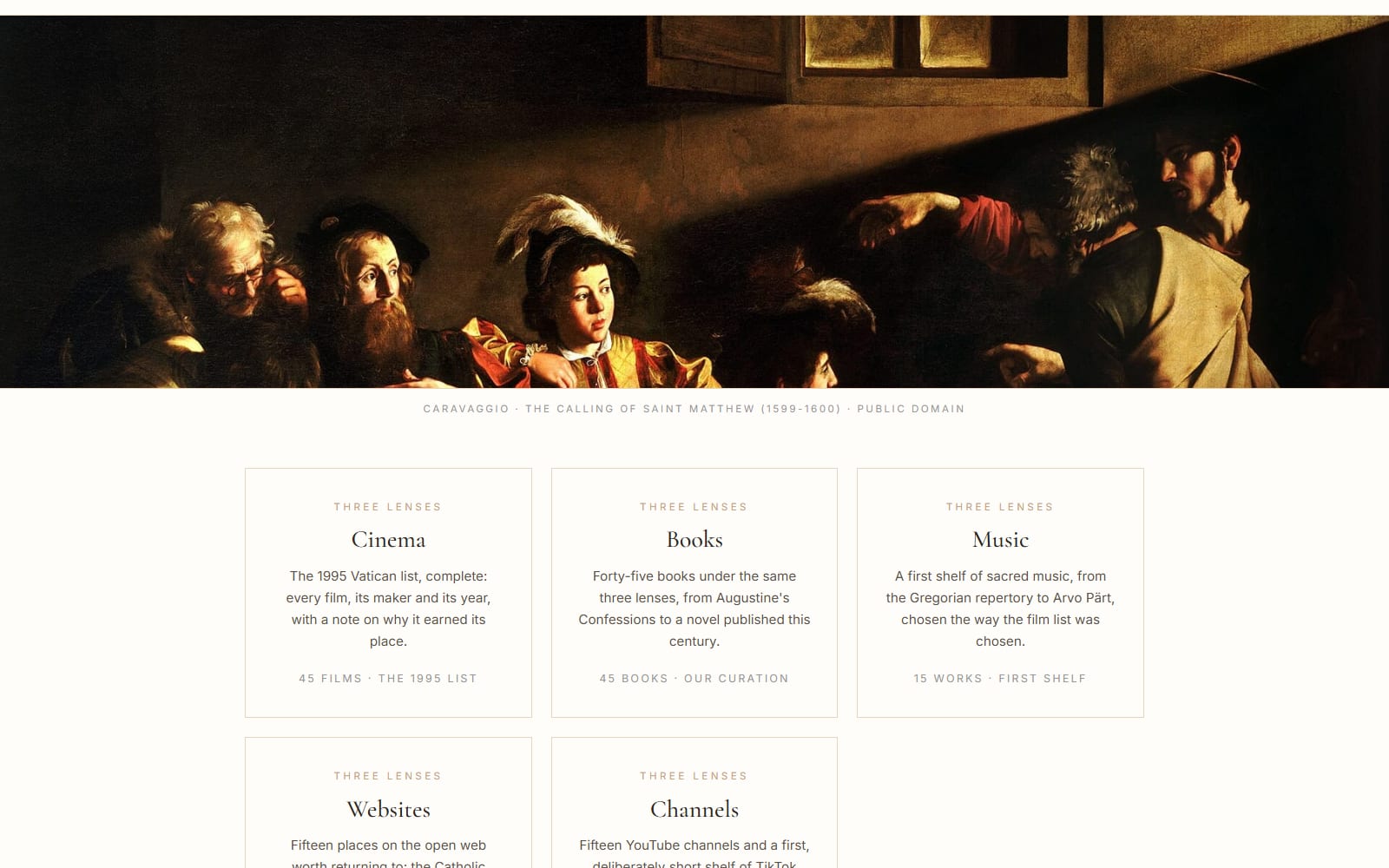
Catholic Curation is a small site that takes the 1995 list as its founding document and extends its discipline sideways: the full film list, verified; forty-five books under the same three lenses, from Augustine's Confessions to a novel published this century; and a first shelf of fifteen works of sacred music, from the Gregorian repertory to Arvo Pärt's Passio. English and Portuguese, every entry with a one-or-two-sentence note saying why it earned its place, and a rule that the note must contain a fact about the work rather than an adjective about it.
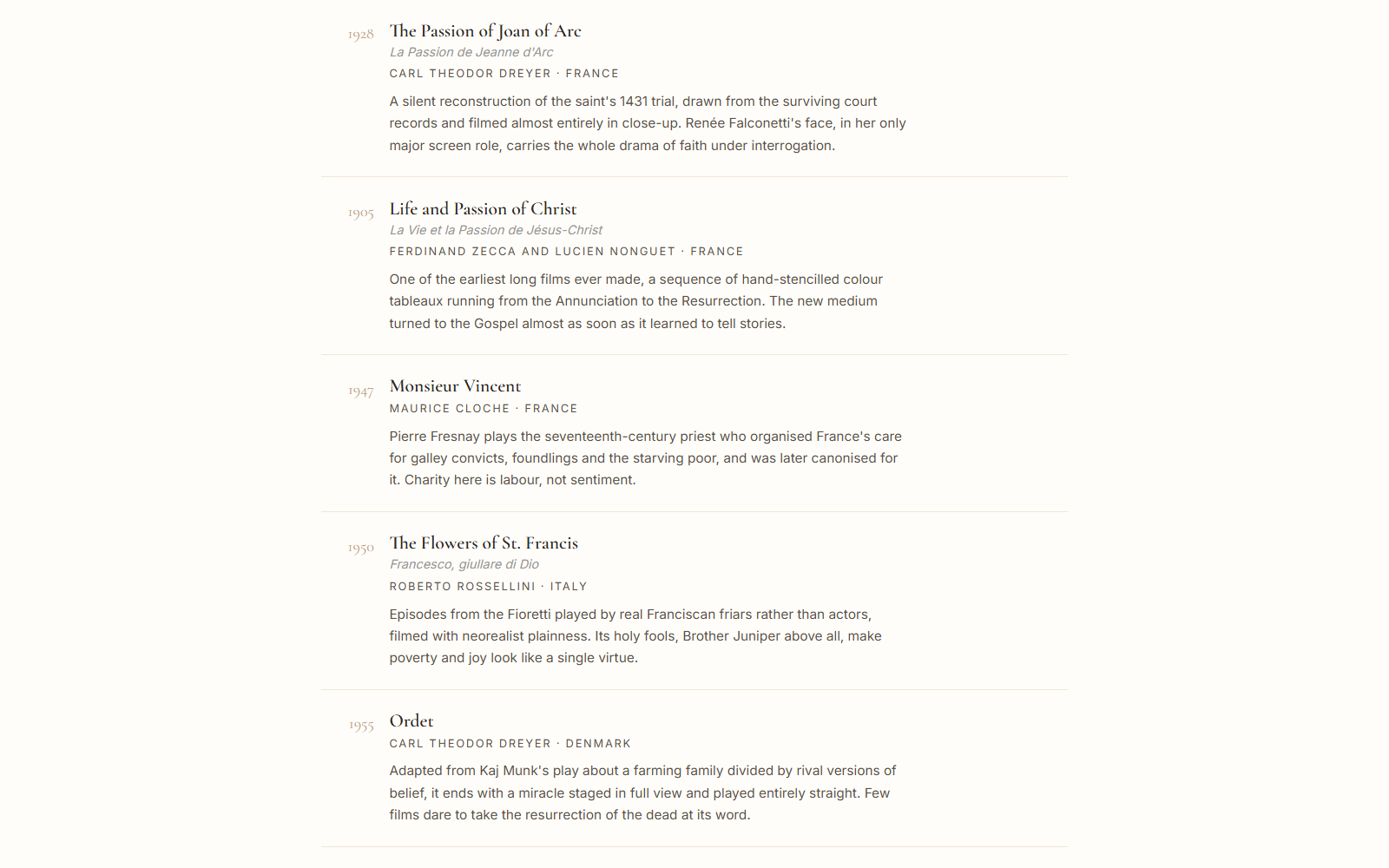
The verification mattered more than it might seem. The 1995 list exists on the open web in slightly disagreeing copies, so two independent research passes reconstructed it from different sources and were only trusted when they agreed, which they did, on all forty-five titles and every category assignment. The books and music shelves carry no such authority and say so on the page: the Church never issued a list of books the way it issued the list of films, so those shelves are this project's own curation, made in the spirit of the original and answerable to its three lenses.
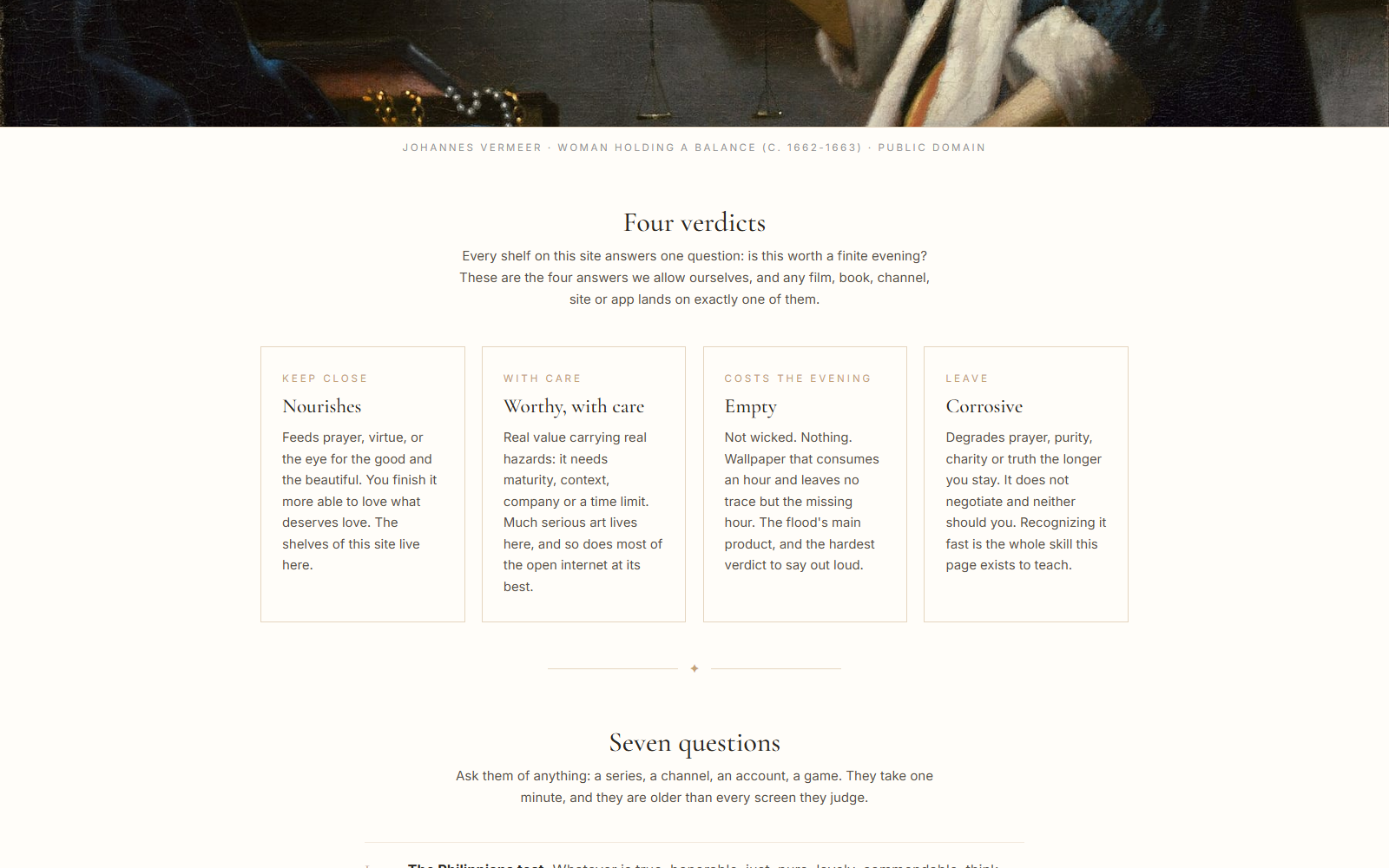
The design follows the standards of the house it honours. The current vatican.va runs on Cormorant Garamond over Inter, parchment and travertine tones, thin gold rules; I read the palette out of its own stylesheet and used the same freely licensed faces. What the site deliberately does not borrow is identity: the mark is a plain Chi-Rho rather than anyone's insignia, and the footer of every page says what the project is not: not affiliated with, endorsed by, or connected to the Holy See. Honouring a visual standard and impersonating an institution are different acts, and the difference is a disclaimer nobody has to search for.
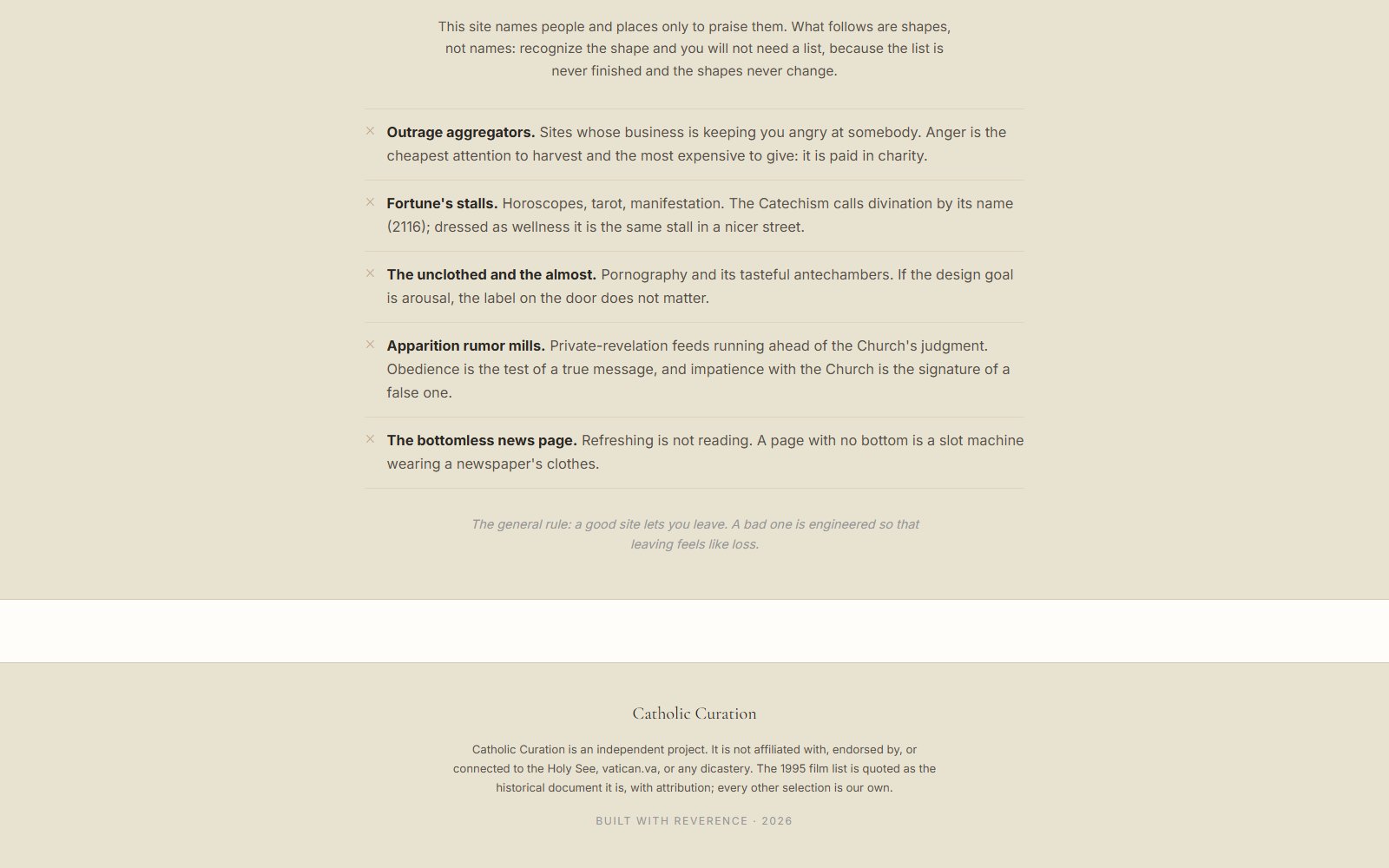
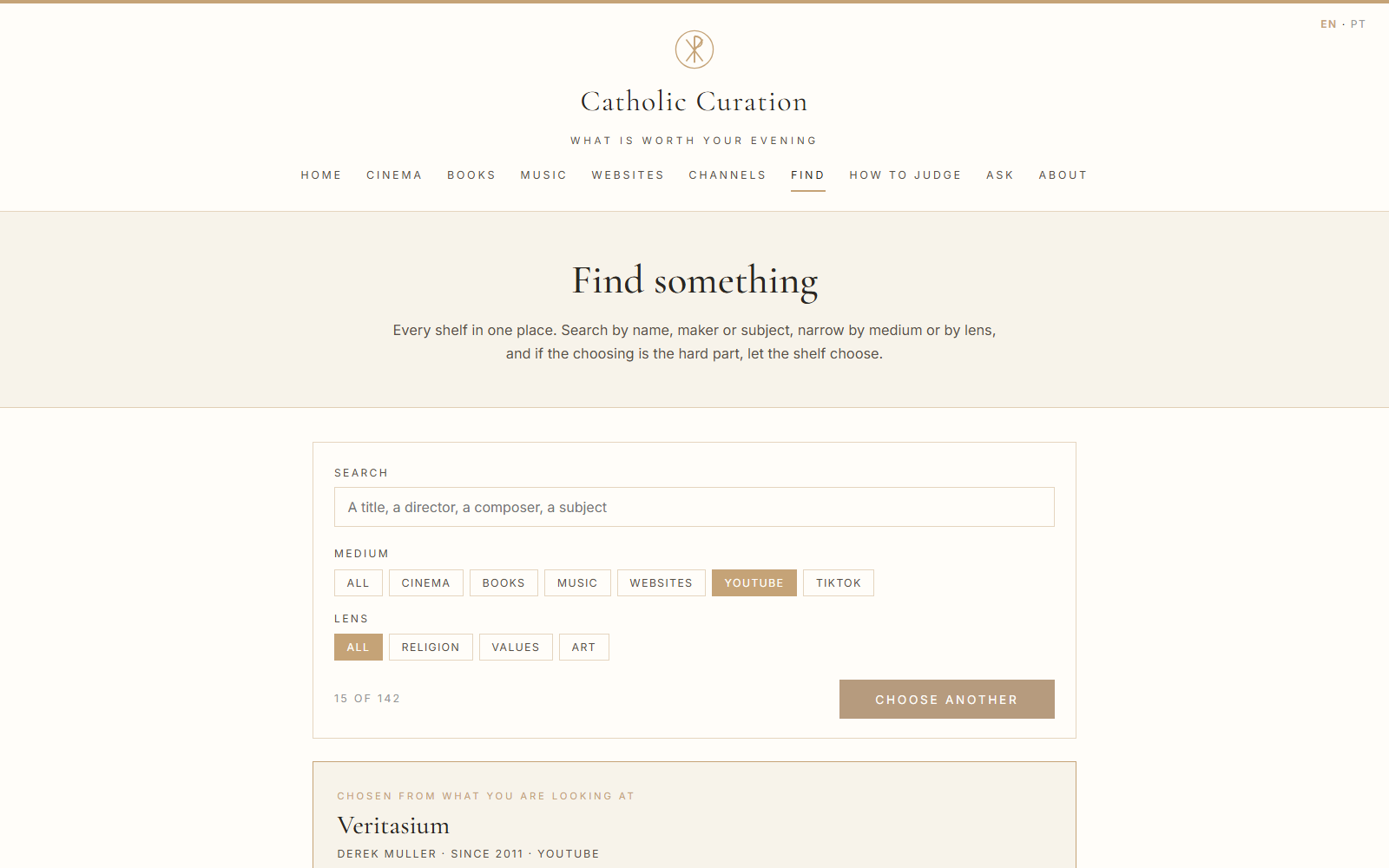
The rule of the shelves
A work enters a shelf when it has carried the faith, formed consciences, or set a standard of art, and when someone can say why in one sentence. That last clause does the real work. It is easy to admire vaguely; a shelf forces the admiration to commit. Writing one hundred and five of those sentences, in two languages, taught me more about the works than a month of reading about them would have, because "why does this belong here" is a question with no room for filler.
And the lists are small on purpose. Fifteen per lens, forty-five per art form, finished. A shelf you can finish is a different instrument from a feed you cannot: it makes a claim, it takes a risk, it can be argued with, and when you reach the end of it something has been transmitted. The feed's whole design is that you never reach the end and nothing is ever claimed. The 1995 list turned thirty last year and people still argue about what it left off, which is exactly the compliment a list wants. Nobody argues with a recommendation algorithm. They just keep scrolling it.
Why this, why now
The ownership essay in this series stood on a line from 1891; this project stands on one from 1995. The pattern is the same and I am no longer surprised by it: the tradition keeps turning out to have already answered questions the technology only just made urgent. The Church curated for fifteen centuries before anyone needed the word. It chose which books entered the canon of Scripture, which music was fit for the altar, which feasts ordered the year. The 1995 film list was that same muscle applied to an art form barely older than its author's lifetime, and the flood of generated culture has now made the gesture valuable everywhere: when anything can be made in a minute, the choosing becomes the work, and the chooser's authority comes from exactly one place, a formed hierarchy of values that the reader can inspect and hold them to.
That is also why this could not be an algorithm. A recommendation engine optimizes for what you will click, which is a fact about your reflexes. A shelf commits to what is worth your attention, which is a claim about the good, and claims about the good can only be made by someone standing somewhere. The site says where it stands in its first sentence.
The shelves will fill slowly, art and poetry are obvious next rooms, and the build stays a private proof of concept while they do, which is the right order: the 1995 list took a committee of twelve and a hundred years of cinema to pick forty-five films, and the restraint is most of what makes it trustworthy. If a parish, a school, or a family wanted to run its own shelf, the tooling is now trivial, one data file and an afternoon. The taste is the part that cannot be generated, and it turns out the tradition has been growing that for two thousand years.
The feed will keep getting deeper. The shelf is how somebody who loves you says: start here.
Questions this article answers
What is the Vatican's 1995 list of films?
Forty-five films issued for the centenary of the Lumiere brothers' first public screening by the Pontifical Council for Social Communications, the Vatican's office for media, working alongside the Vatican Film Library that John XXIII founded. A committee of twelve film scholars sorted them into three categories of fifteen, Religion, Values and Art, which is how Dreyer, Tarkovsky, Pasolini, Bunuel and Kubrick end up on the same document. It banned nothing: it is a list of what deserves attention, not a catalogue of what does not.
Is Catholic Curation an official Vatican project?
No. The footer of every page says the project is not affiliated with, endorsed by, or connected to the Holy See, and the mark is a plain Chi-Rho rather than anyone's insignia. Only the film list carries Rome's authority; the Church never issued a list of books the way it issued the list of films, so the books and music shelves are this project's own curation and say so on the page. The design does follow vatican.va's standards, Cormorant Garamond over Inter and parchment and travertine tones read out of its own stylesheet, because honouring a visual standard and impersonating an institution are different acts.
Why is a fixed list of forty-five better than a recommendation algorithm?
Because the two answer different questions. A recommendation engine optimizes for what you will click, which is a fact about your reflexes; a shelf commits to what is worth your attention, which is a claim about the good, and claims about the good can only be made by someone standing somewhere. A list you can finish also takes a risk you can hold it to: the 1995 list turned thirty last year and people still argue about what it left off, which is exactly the compliment a list wants.
Could I run a shelf like this for my parish, school or family?
Yes, and the tooling is now trivial, one data file and an afternoon. The hard part is the rule rather than the code: a work enters a shelf when it has carried the faith, formed consciences, or set a standard of art, and when someone can say why in one sentence. The restraint is most of what makes the original trustworthy, since a committee of twelve took a hundred years of cinema and picked forty-five, and the taste is the part that cannot be generated.
Read next
 AI
AIThe Feed Is Infinite. Your Evening Is Not.
Sixteen essays in a month from a blog that used to manage two in three years. That is what the supply side looks like now, and every maker is living some version of it. This one is about the other side: what happens to attention, consumption and payment when making stops being the hard part. The middle dies, the evening becomes the unit of account, the working day runs on the same budget, and attention turns out to be an inventory of what you love. AI
AIWhen the AI Has to Film Its Own Review
When a pull request is raised, mine or one I have to review, I now ask the agent to run it on my machine, try to break it and film itself doing it. A paragraph can claim a test happened. A recording has to show it, and deciding what it means is still my job.