
Who Owns the Work That Teaches the Machines?
Listen to this article (experimental) · 33:00

Text ran out. The models that write and reason were trained on the internet, and the next generation has to act in the physical world: clear a hedge, replace a slipped slate, read rough ground before a drop. That footage does not exist on the web at any useful scale. It has to be filmed by people who know the work, under real conditions, with the mistakes and the recoveries left in, because the mistakes are where the skill is.
Right now the people who can produce it are giving it away, on platforms, for ad revenue that rounds to nothing. And the labs that need it will pay for it, once somebody can sell it with consent and provenance attached.
So I built the somebody, as a proof of concept: a partnership that holds the corpus, admits members by vouch, licenses footage to buyers, and pays the people who filmed it a share of every sale, for as long as the work keeps selling. It is called a guild, on purpose, and it is a private-property design from top to bottom: each clip stays its maker's own asset, the guild is the members' selling agent rather than their owner, and anyone can leave with their asset any day. This article walks the context that forced the idea, the product it forced, the measured financials, and where it could all go.
Where the idea comes from
Start with what the 1891 document actually is, because its reputation precedes it in the wrong direction. Rerum Novarum (Leo XIII, 1891) rejects socialism by name in its opening pages and defends private property as a natural right; its remedy for the condition of working people is not redistribution but that more of them become owners. The same document laments that "the ancient workingmen's guilds were abolished in the last century, and no other protective organization took their place" (no. 3), and the tradition that follows argues for ownership in more hands, against both state collectivism and pure wage labour, never toward the first. Quadragesimo Anno (Pius XI, 1931) advised that, so far as possible, the work contract be modified by a contract of partnership, so that workers become sharers in ownership or in management, or share in some fashion in the profits (no. 65). And this year, Leo XIV's Magnifica Humanitas counted "patents, algorithms, digital platforms, technological infrastructure and data" among the goods meant for everyone, warning of them concentrated "in the hands of a few, without adequate forms of sharing and access" (no. 67). The same encyclical sets the test this article keeps returning to: automation "must not be evaluated solely in terms of efficiency, but in relation to the dignity of the worker, the right to sufficient remuneration and the genuine possibility of participating in society" (no. 37).
The arrangement being asked for is ordinary, not utopian: when a lawyer makes partner, they stop living on salary alone and take a share of the firm's profits, and Goldman Sachs ran exactly that way for its first 130 years, until it listed in 1999. Music has run on the same rail for a century: the songwriter owns the song, a rights body licenses the catalogue, and every play pays the owner. Royalties are what ownership looks like when the asset is small and the sales are many.
Now start where Elon Musk ends. He has said it plainly for two years: AI plus robots will be able to do everything, resulting in universal high income, and work will be optional, with money itself, at some point, becoming irrelevant. Suppose he is right. That future is the stated destination of the people building embodied AI, and the footage this article is about is fuel for exactly that machine.
Two things stay true even if the destination arrives. The transition is long, and during it money matters more than ever, because the income from automation flows to whoever owns the models, the robots and the training data while wages contract around them. And Leo XIV's test applies at the far end too: what a person needs is not only to survive, which a transfer payment can arrange, but the genuine possibility of participating. An allowance is what you give someone the system no longer needs, and being needed is most of what work gives a person. No cheque replaces that.
So the practical question is what an ordinary skilled person can hold through the transition. Not the models, not the chips, not the robot fleets. The one input they alone produce is the demonstration: skilled work, done under real conditions, on camera. Their labour is becoming training data in front of them, and today it leaves them for nothing, scraped or signed away in a platform's terms.
Hold on to that one asset and the system in this article derives itself. If the data is the asset, it must not be sold once and gone, so payment is a recurring share rather than a fee. If thousands of people hold shares, thousands of small payments must move every week, so settlement has to cost next to nothing, which is where the chain earns its seat. If people are identifiable in the footage, consent has to be real, revocable and provable, or no serious buyer can touch the corpus. And since one gardener has no bargaining power and cannot indemnify a lab, the sellers need one professional desk to sell through, the way photographers license through an agency and songwriters through a rights body, and a body of tradespeople with admission rules, quality control and one desk that sells for all of them has had a name for a thousand years. Nothing here is decoration. Each piece is forced by the one before it.
That is what building the system buys over holding the opinion. The encyclical says workers should share in what their work produces; Musk says money eventually ends; neither says what to do on Monday. A mechanism does. And a mechanism can be measured. The measurements further down show the shape every royalty market has, music, film and photography included: earnings follow demand, most of the catalogue earns little, and the work that keeps selling carries the rest. Knowing that shape up front is what lets this article make the promise the arithmetic supports, a royalty on demand, where what pays is the clip that buyers keep licensing, not the volume filmed, instead of the easy one, "everyone earns from their data".
This is already happening, unpaid
The pattern is not a forecast. Claude Skills let a person package how they do a piece of work, the checklist, the house style, the order of operations, the things that only come from having done it, so a model can carry it out that way. People are writing them now, and giving them away.
Be precise about the mechanism, because the analogy is easy to overstate: a skill is not training data. It steers a model at run time rather than being baked into weights, and the author keeps the file. What it does share with this design is the part that matters: expertise that only exists because someone spent years acquiring it, formalised into something a machine can execute, handed over for nothing.
That is knowledge work, where the packaging is text and a person can write it themselves. The physical trades are the harder half of the same problem: you cannot type a skill file for reading rough ground or feeling when a joint is about to fail, so the packaging has to be capture, and capture needs consent, provenance and somebody to indemnify it. If the knowledge-work version is already running on goodwill, the question is whether the embodied version arrives the same way, filmed for free by people pleased to be useful, or whether the people doing the filming end up holding a share of it.
The market already exists, and it pays a wage
The money is already moving, so the design has to position itself against what people are actually being offered rather than against nothing.
Tesla advertises $25.25 to $34.50 an hour, plus cash and stock awards, for data collection operators in Palo Alto: wear motion capture equipment, walk predetermined routes carrying up to thirty pounds of gear, seven-plus hours a day, and write up what went wrong. That is a real job at a real wage, hiring now for Optimus. CrowdBrain is building what it calls the human infrastructure layer for physical AI, and it is on Solana too: operators train in simulation, prove quality through labelling, and unlock live teleoperation of real robot arms, with portable credentials and bonded robot nodes. Human Archive pays gig workers in India to wear camera-equipped caps and collect real-world footage.
All three are the wage contract, and that is a description, not a criticism. CrowdBrain states the structure plainly in its own pitch: every task generates verified customer output and also compounds into the company's robotics data library. The operator is paid for the task. The library accrues to the company. Do that a million times and you have rebuilt exactly the concentration Magnifica Humanitas names, with better UX and a token.
So the difference this project tests is not the data. It is the terms. Same footage, same buyers, and the question is whether the person who filmed it holds a share of what it earns for as long as it earns, or is paid once and done. That is Quadragesimo Anno's wage contract modified by a contract of partnership, which is either the whole point or an affectation, and the measurements further down decide which.
And the wage is currently the better deal, which has to be said. $34.50 an hour is money this week; the share only wins if the corpus keeps earning for years, and no lab has agreed to buy anything yet. Anyone choosing between the two today should take the wage. What this design has to earn is the version of that choice five years in.
Does simulation make this unnecessary?
The strongest objection came early, from a childhood friend who is not building any robots: he likes to be in the markets, and he uses programming and AI to stay ahead of them. It is exactly the objection the people who are building the robots would make: simulation might make human demonstrations worthless before any of this matters. Tesla is building a 3D simulator for humanoids much as it did for its driving stack, and if the simulator matches the hardware closely enough, most training happens in software, where it is enormously faster and cheaper than moving real arms.
The answer is not that simulation will fail. It is what anyone who has shipped a sim-to-real system says next: what worked in simulation has to be tested against reality and the offsets adjusted, and the hard part is making the simulation real enough that the offsets are small. That never stops needing real footage of real work under real conditions. It changes what the footage is for. Bulk demonstration data is what a simulator reduces demand for. Ground truth is what it increases demand for, because a simulator is only as good as the reality you correct it against, and correcting it requires footage of the awkward, badly-lit, non-repeating cases a simulator does not know it is getting wrong. That is a smaller corpus where each clip is worth more, and where provenance matters more rather than less, because a wrong correction is worse than no correction.
CrowdBrain's own pipeline says the same thing from the other end: operators train in simulation and then step onto real hardware, and the reason the human layer exists at all is that people have to demonstrate tasks and step in when autonomy breaks. Nobody building this expects simulation to remove the human.
The product
Not a whitepaper. A working guild, end to end, with every money figure in this article measured against the real Solana runtime rather than assumed. Here is the whole machine at a high level: members film, the guild clears and bundles, buyers license, and the money divides itself by rules everyone signed. Nothing is owned in common at any point: a clip remains its maker's property, licensed through the guild the way a song is licensed through a rights body, and the guild's own income is a five percent fee for the selling, not a claim on anyone's asset.
A member films a job on their phone, files a signed record of it, and three other members score it before it can be sold: the verdict is the median, so one enthusiast or one grudge moves nothing. Cleared clips are bundled into corpora by trade, committed cryptographically so that nothing can be swapped or slipped in later, and priced by weight, a clip's capped minutes times the score it earned. A buyer can verify any clip against that commitment themselves, in the browser.
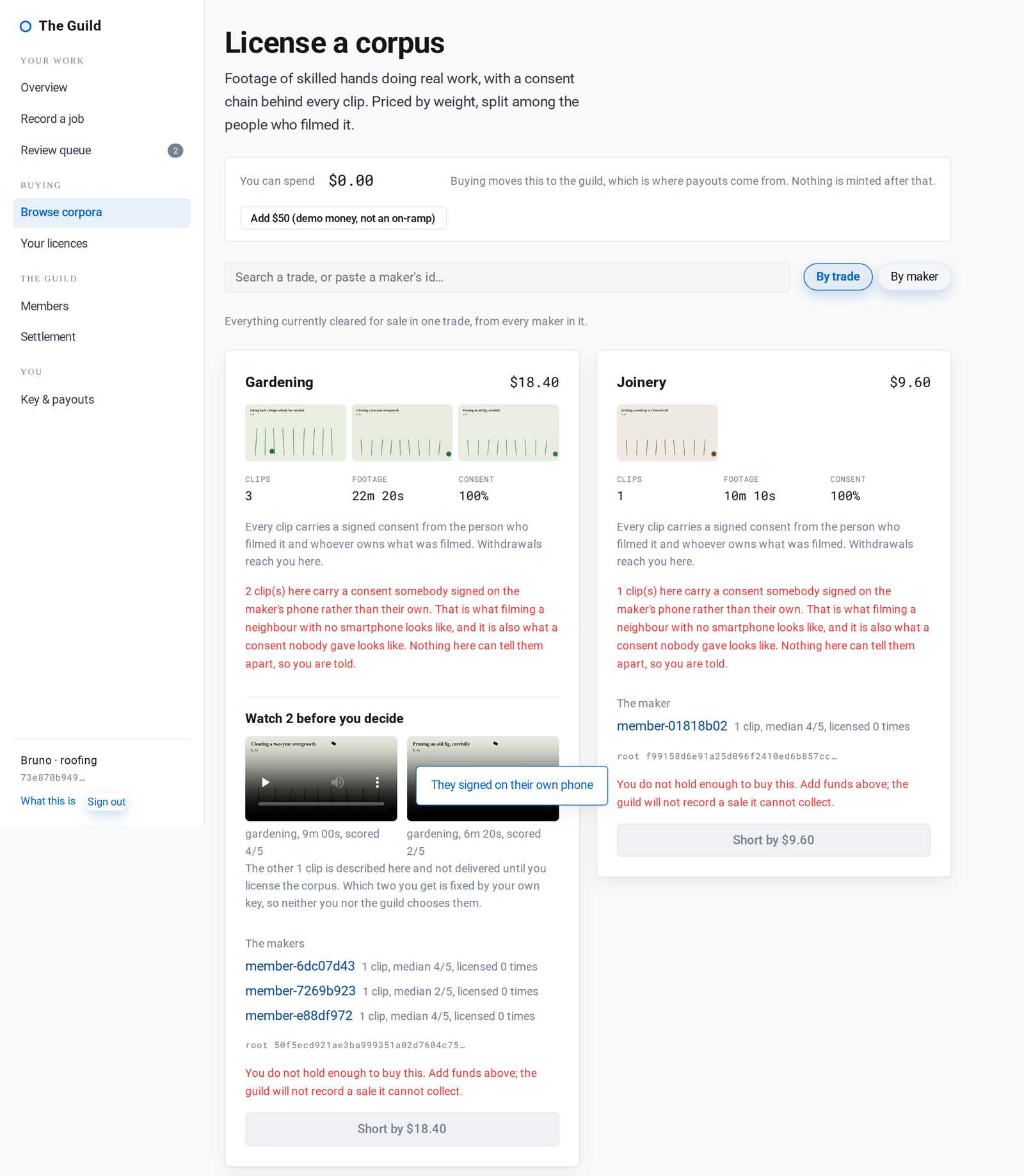
A buyer evaluates on a two-clip sample chosen by hashing their own key against the corpus, so neither side picks the shop window, and at least one clip is always held back. The rest is described, not delivered, because once somebody holds the footage nothing distinguishes a licensee from someone who copied it. The pixels are not the moat. The consent chain is.
Every clip carries signed consent from the person filming, whoever owns what was filmed, and anyone identifiable in frame. The interesting part is where those signatures happen.
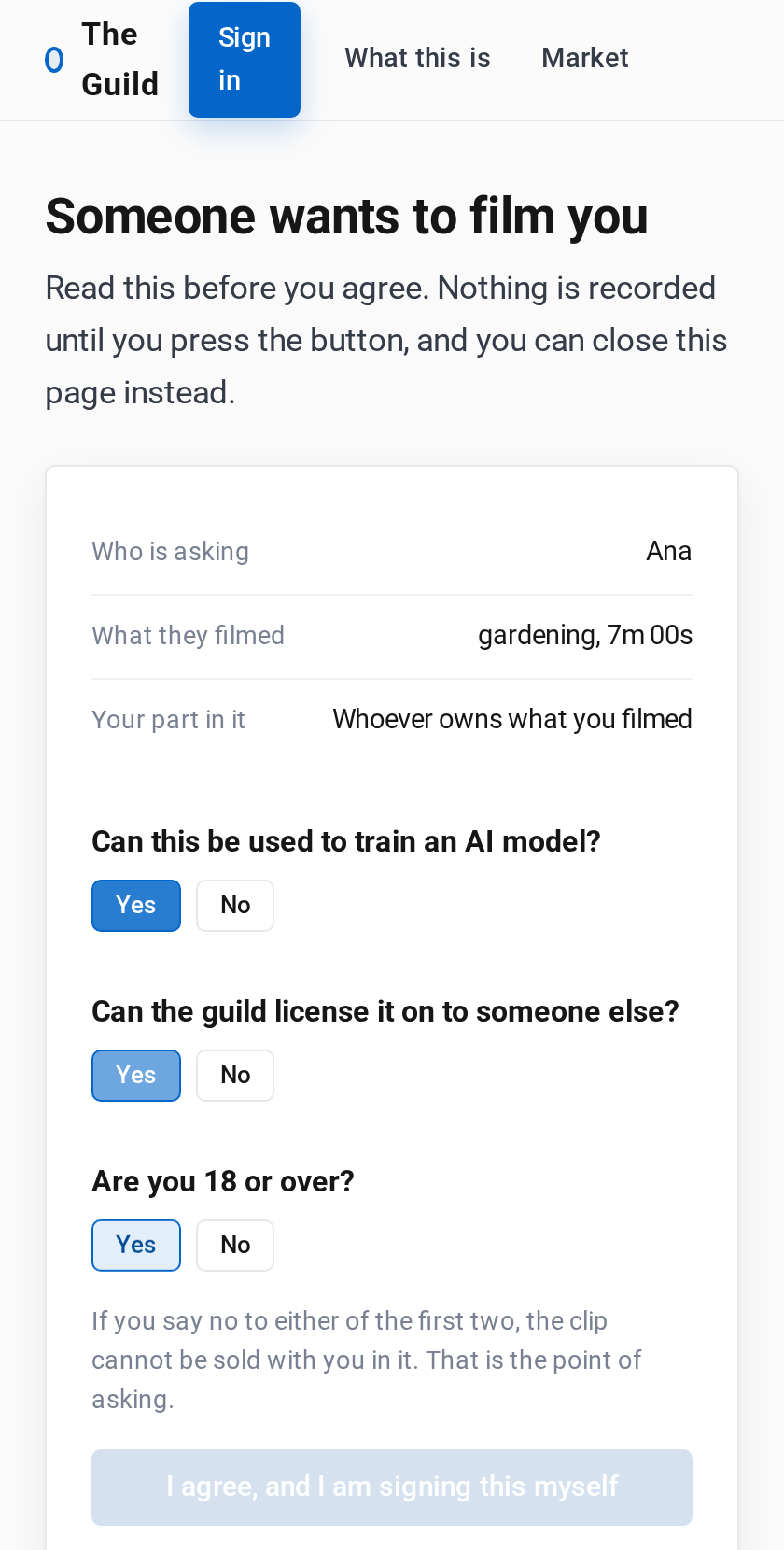
A homeowner signs on her own phone. Her browser generates the key and the withdrawal secret, and the maker's device never holds either, so there is nothing on his screen to keep a copy of. Handing the maker's phone over still works, for the neighbour who does not carry a smartphone, and the record says which of the two happened, permanently, because it is bound into what she signed. The corpus publishes the count, and a buyer sees it before paying: a handed-over consent is what filming a neighbour looks like, and it is also what a consent nobody gave looks like, and no software can tell them apart. So the buyer is told.
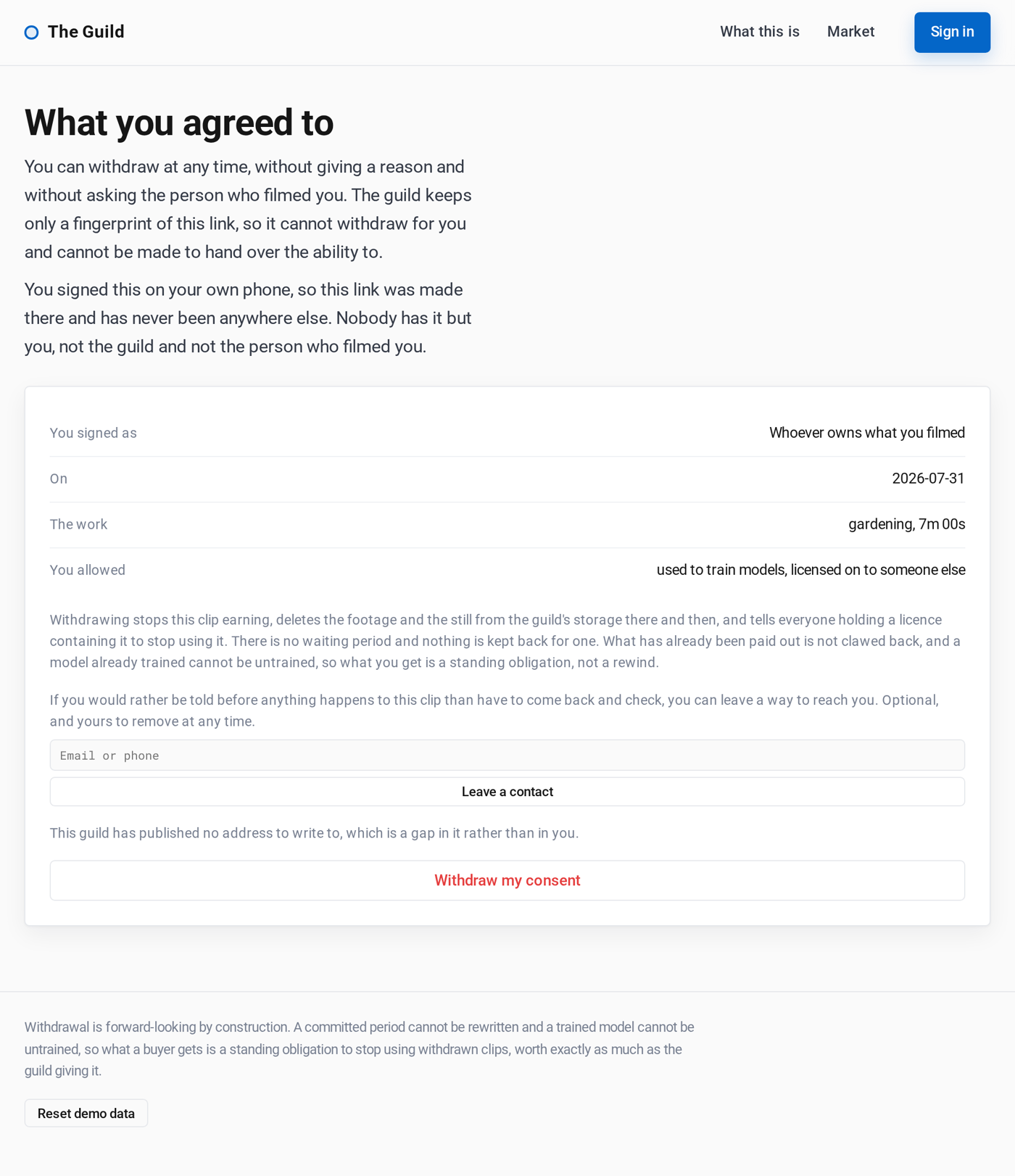
She walks away with a link that is hers alone. Opening it shows what she agreed to and a button to withdraw, no reason required, no account needed, and the guild cannot do it for her because it holds only a fingerprint of her secret. Withdrawal takes effect at once: the clip stops earning, the footage and its thumbnail are deleted from the guild's storage there and then, every buyer holding it is notified and refunded the undelivered part of their licence, and each buyer signs an acknowledgement with the same key that bought it. That signature is the buyer's compliance evidence and the guild's enforcement evidence, one artefact doing both jobs.
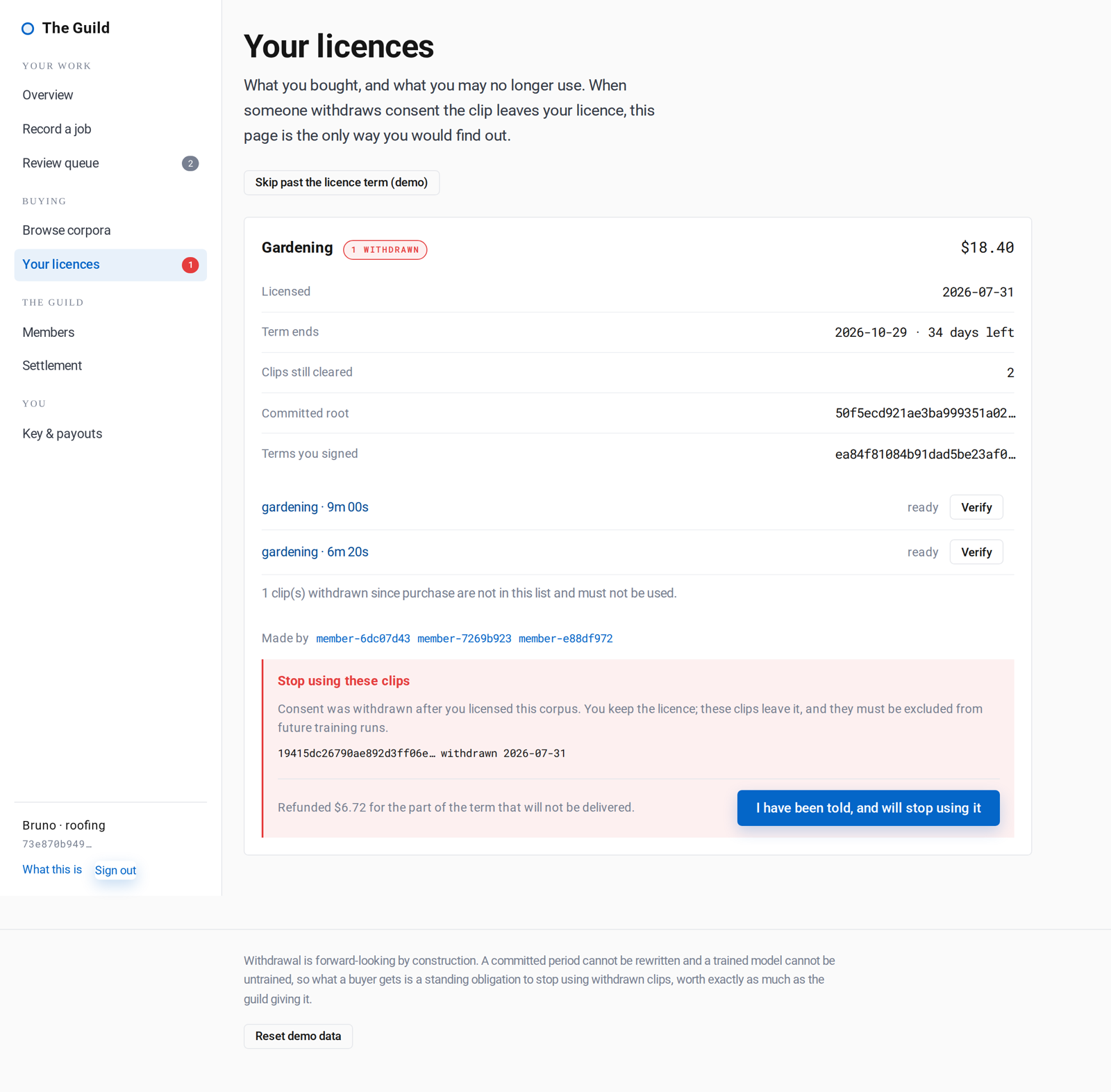
Withdrawal is forward-looking by construction, and the licence says so instead of hiding it: a model already trained cannot be untrained, so what the buyer owes is deletion and exclusion from future training, within five business days, with no unlearning demand ever. A model whose training finished inside the licence window is the buyer's to keep operating, permanently. That clause is what makes the deal signable, and the person in the clip is protected by the other side of the same design: her withdrawal is instant precisely because the guild releases a sale to members only as the licence is delivered, so there is always undelivered money left to refund the buyer with.
Both sides sign, and both signatures are checked. The buyer does not click a checkbox: the twelve clauses of the licence are displayed in full, and the acceptance is signed with the same key that pays, over the exact text shown, the corpus commitment, and the exact price, so which text a buyer agreed to is answerable years later.

Members sign a versioned document too, seventeen clauses hashed into their membership record, and most of them are not about money. They say what a member is: not an employee, no shifts, no quotas, nothing exclusive, scoring other members' work voluntary, tax and social security their own. Two clauses concede in writing that behaviour rather than wording decides employment status, because it does, and a guild that starts assigning work will be called an employer by a court whatever its terms say.
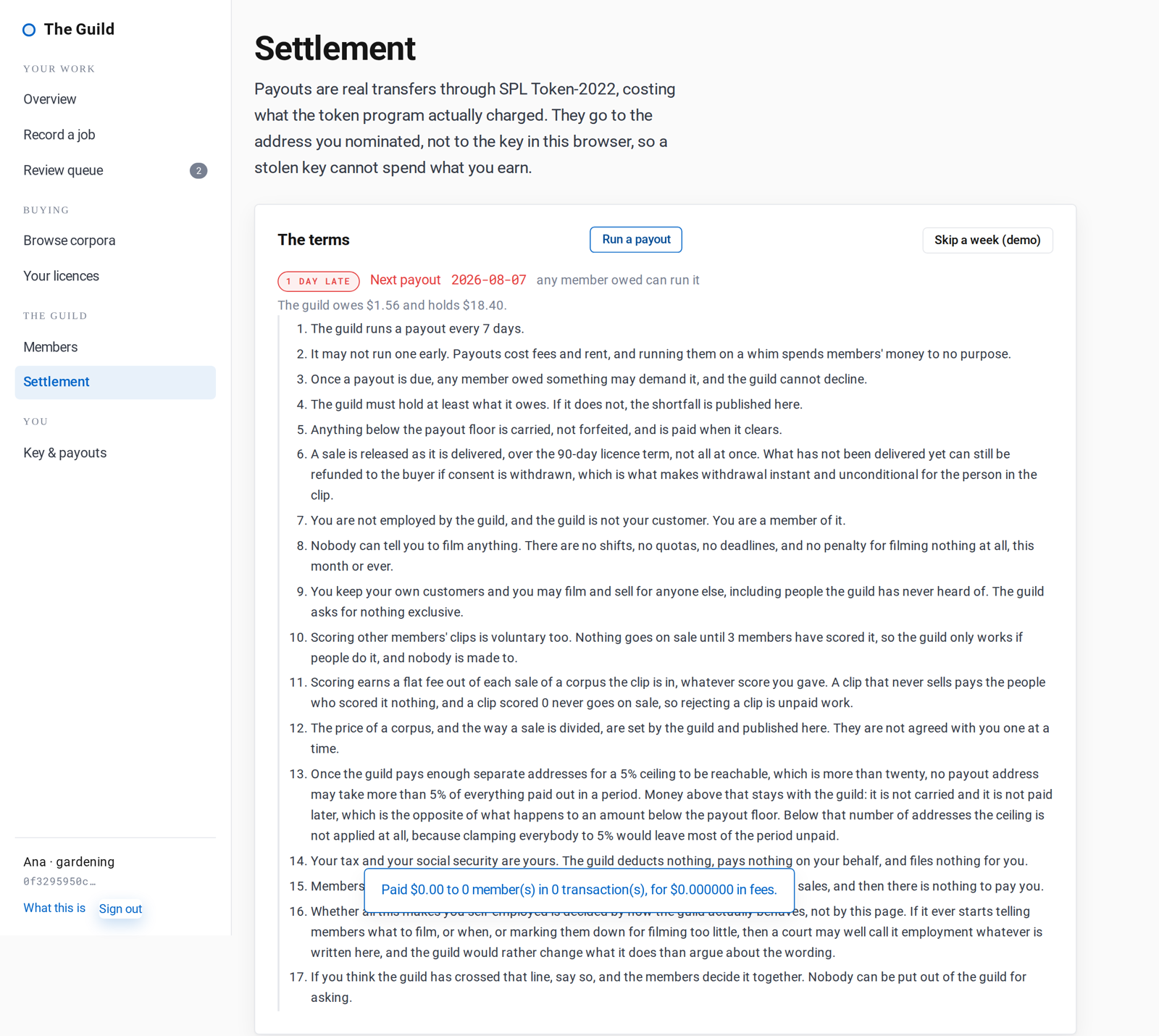
Money in one sale, end to end, so nothing hides in a percentage. The agent in the next section buys the gardening corpus for $11.68. Five percent, 58 cents, is the guild's, and it is the guild's entire income: storage, legal, audit and answering the phone come out of it. Up to seven percent, 82 cents here, pays the members who scored the clips, a flat fee per review so that no particular score pays better than another. The remaining $10.28 belongs to the makers, split by weight, and it reaches them as the licence is delivered, roughly a thirteenth with each weekly payout across the 90-day term. Everyone is paid in USDC to an address they nominated and control. If the buyer stops early, the makers keep every delivered cent, the buyer gets back the rest, and the guild's five percent rides only on what was actually delivered.
The buyer might not be human
Everything a buyer does here is already a protocol: hold a key, fetch a quote, sign the exact clauses, pay in USDC, collect the footage. A person clicks through it; an agent would just call it. The purchase route answers an unpaid request with HTTP status 402 and the terms of payment in the body, the amount, the currency and the clauses to sign, which is the x402 exchange with only the settlement rail left to plug in: the status code reserved since the nineties for exactly this, a request that comes back priced, is paid in stablecoin, and goes through, machine to machine, with no procurement department in the loop. The infrastructure side is moving first: the day before this article's date, Cloudflare announced Wallets, programmable wallets with spending caps that let agents pay for APIs and content over exactly this 402 exchange, in stablecoins, with no human in the payment loop.
An agent also does not want ninety days of anything. It wants the corpus while it trains and evaluates, and nothing after. The machinery already points there: money is released to members only as the licence is delivered, and the undelivered part refunds, so a licence an agent ends early is arithmetic the settlement already knows how to do. The term becomes a meter.
While this article was being written, that stopped being a thought experiment. The project now contains a buyer that is a program: it mints its own key, proves it holds it, reads the market, gets the 402, pays, signs the twelve clauses, buys, checks a clip against the committed corpus with its own hashing, and thirty days later ends the licence and takes the refund for the two thirds it no longer wants. Its run, verbatim, with its one stand-in named in its own output:
agent   key minted            0a22d6d171da6b0e…
agent   session opened        signed the server's nonce, no password anywhere
agent   corpus chosen         ds-trade-gardening, 2 clips, $11.68
server  HTTP 402 Payment Required   11.68 USDC via demo-balance
agent   paid                  $12.00 demo top-up, standing in for an x402 USDC settlement
server  HTTP 201 licensed        lic-1, 12 clauses signed with the paying key
agent   proof checked         clip sample-0 against root 684b9def36a7…: verifies
clock   30 days pass          the agent trains; a third of the term is delivered
server  HTTP 200 ended           33.3% delivered and released to the makers, $7.79 refunded for the rest
agent   done                  bought, verified, used, ended: a licence held exactly as long as it was needed, by nobody
The stand-in is the payment leg, which settles against a demo balance because the ledger lives in one process; the message shapes are x402's, and a production guild swaps that one scheme for a wallet address. Everything else in that run, the session, the signature over the clauses, the proof, the signed early end and the refund to the cent, is the same machinery a human buyer uses.
That, and not loyalty to any chain, is the commercial argument for settling in stablecoin: machine buyers pay machine money. A lab's accounts payable can send a bank transfer; an agent cannot. The chain earns its place the day the buyer is software.
The results
The project's report page regenerates from a live measurement pass, so it cannot drift from what the code produced, and the financial question it answers is the one that could disqualify the whole design: does an ordinary organisation with a bank account already do this job? If yes, the chain is decoration, and decoration built on other people's time is worse than nothing. Some of what it says is comfortable: fees are tiny, a full batch pays nineteen members in one transaction, and the packing limit is the network packet, not the budget.
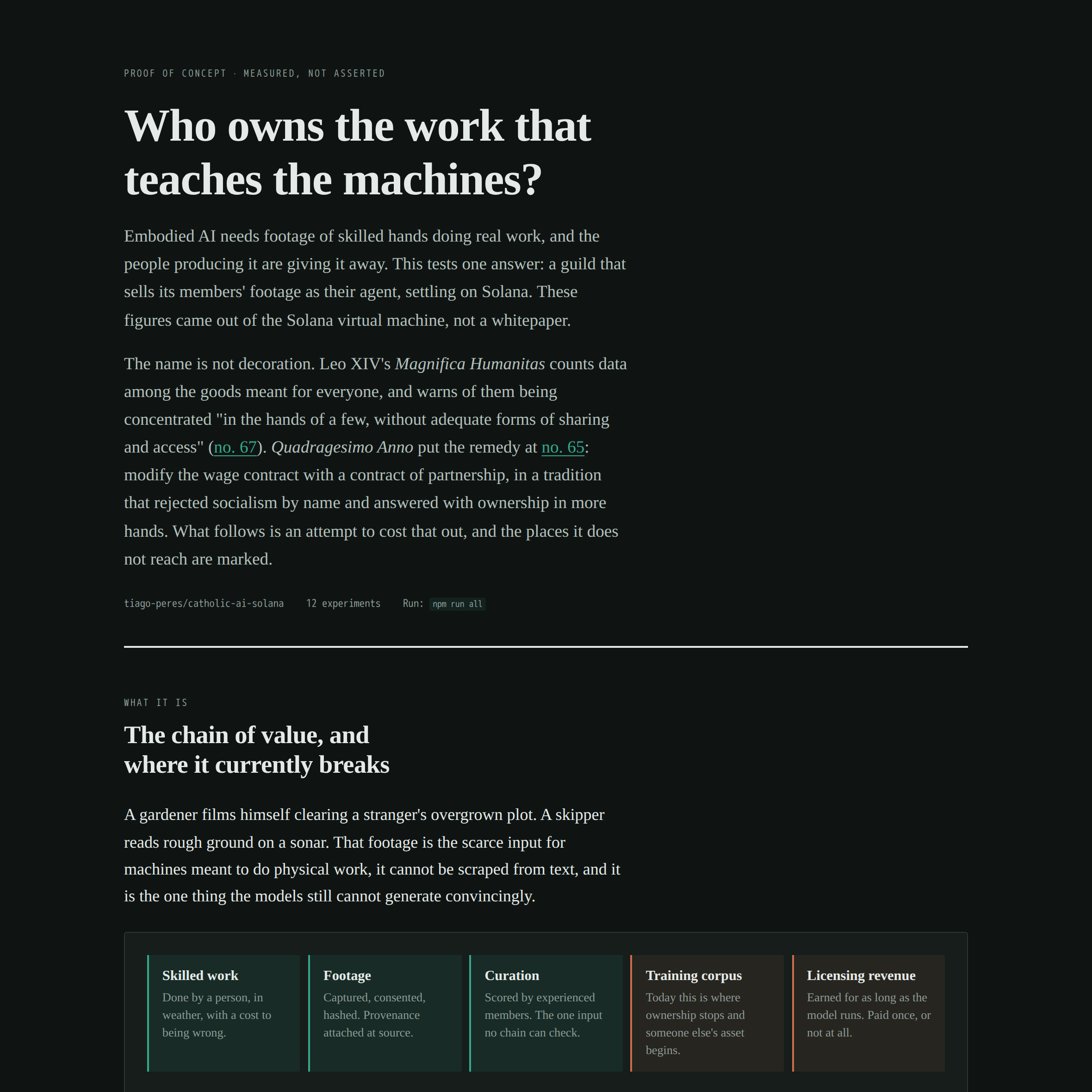
The most valuable results are the ones that set expectations, and they describe a market everyone already lives in.
The long tail earns little. At 5,000 members and $12,000 of annual revenue, 288 members clear the $1 payout floor and the smallest earners would take 21.3 years to cross it. Cheap settlement does not change that, because the rail was never the question: a small contribution is worth a small amount. That is the shape of YouTube, of X's ad-revenue sharing, of streaming royalties, of every market where many publish and demand picks what pays; millions upload daily knowing most clips earn cents, and it stops nobody. What the guild changes is not the curve but the terms on it: on the platforms the library accrues to the company and the creator is paid from advertising crumbs, while here the clip stays the maker's property and earns a licensing royalty every time it sells. The pitch that survives is a royalty on what sells, not "everyone earns from their data": filming a lot guarantees nothing, and a few clips that buyers keep licensing can out-earn a thousand that they do not.
What selling enough means has a number. The app works it out on its own landing page: a ten-minute clip scored top by the panel returns $10.56 to its maker every time a corpus containing it sells. An income of EUR 1,000 a month is therefore about 103 clip-sales a month: 103 clips each selling once, 21 clips each selling five times, or 11 selling ten, and under the 5% ceiling the guild has to be turning over about $24,500 a month before any one member may take that much out of it. Nobody quits a trade for this on day one. The realistic shape is a royalty on work already being done, filmed as it happens, that pays again at every sale and every renewal for as long as the clip stays consented, and compounds as the corpus and the buyer list grow.
What the guild itself pays is settled arithmetic, and there is no bank anywhere in it. At 40,000 members paid weekly, two million payments a year, settlement costs $51 a year, converted at SOL's market price on the day of the measurement, $73.50 on July 31: 335 lamports a payment, nineteen payments to a transaction, every payout USDC on Solana into an account the member controls. The incumbent doing the same job comes to $21,400 a year at the model's central prices, a cent per payment in a bulk bank file plus fifty dollars a month for the platform that sends it, and both of those prices are asserted, labelled unverified in the source, and waiting on two real quotes. So the claim that survives is a range, not a point: across the whole published sweep, from the cheapest bulk file to retail pricing, the guild lands somewhere between roughly ninety and eight thousand times cheaper as a payment system. The quotes would pin the multiple, not the direction.
And the retail end of that sweep has logos on it. Stripe and PayPal, the rails a builder reaches for first, are priced from their own published sheets: PayPal Payouts takes 2% of each payment, and Stripe Connect takes 0.25% plus ten euro cents a payout plus two euros per active account each month. On the model's two million $12 payments a year that is roughly $500,000 for PayPal and $1.3 million for Stripe, most of it the per-account fee, against $51 of settlement. Even the worst case below beats both several times over. The bulk bank file is the incumbent in the comparison precisely because it is the cheapest thing that is not a chain.
Conversion is a different question, and it belongs to the member, not the system. A member holds USDC and turns it into euros if and when they choose: one who spends USDC directly converts never, and one who cashes out yearly pays an asserted fifteen cents for it, about $6,000 across all 40,000. The model also publishes its worst case: if every one of the 40,000 members chose to cash out every month at retail exchange fees, they would together pay $72,000 a year to the exchanges, none of it to or through the guild. That case is not a cost of the system; it is the reason the system is shaped this way. The wage is denominated in a stablecoin rather than SOL, because an income priced by speculation is a lottery ticket, and conversion stays with the member, because forcing everyone through a monthly cash-out would be rebuilding the bank rail at retail prices.
So why SOL with USDC, in one breath: the settlement is dollars a year instead of hundreds of thousands, every payment the guild claims is a transfer anyone can check rather than a line in the guild's own report, membership cannot be sold because the token itself refuses the transfer rather than a policy promising it, and the buyer that is software, from the previous section, can pay machine money but cannot send a bank transfer. On the bank rail, the guild's word is the only evidence there is; the measurements say what that auditability costs, and they cannot say what it is worth, which for a guild whose whole pitch is that nobody has to take its word is not a small omission. Portugal has already paid the price of taking an institution's word: Banco Espírito Santo was still being called solid weeks before the state put up 4.9 billion euros in 2014 to keep it from collapse, the country's biggest banking scandal. There is a second half to this argument, about what always-online institutions expose that offline keys do not, and the next article takes it up.
From two claims to something concrete
Strip everything technical away and the article says this.
Musk says the machines will end with work optional and money irrelevant. Leo XIV says a person needs more than surviving; they need to participate. Take both seriously and the gap between them is the next few decades: a long transition in which the income flows to whoever owns the models, the robots and the data, and in which a cheque without a role answers the smaller half of the problem.
An ordinary skilled person holds exactly one asset in that transition: the demonstration of their skill, filmed as they work. Today they give it away. The old answer, from 1891, written against the collectivists of its day, is that such a person should own what their work produces and charge for it the way owners do, a share for as long as it sells rather than a one-time fee, and the old name for the professional body that sells on its members' behalf is a guild.
What this project adds is the arithmetic. Consent that can be granted and withdrawn by the person filmed, on her own phone, enforced by deletion and refund rather than by promise. A licence whose clauses both sides sign and whose term is a meter, so a buyer, human or software, pays for exactly what was delivered. And payouts that cost the guild $51 a year where the retail rails would charge half a million, in a stablecoin wage the member converts on their own terms. The numbers that set expectations stay in: the long tail earns little, as it does on every platform people already publish into; a living wage needs about a hundred clip-sales a month; and today the hourly wage down the road is the better offer. The claim is not that the guild wins now. It is that the terms are buildable now, and that whoever holds the assets when the transition ends will have set them.
Three things would settle it, none of them code: one letter of intent from a buyer, two real quotes to pin the cost sweep, and a lawyer on the three questions the drafts already name. The build stays private while those drafts wait for counsel, and this article is the tour. The people teaching the machines are filming already. The only question is the terms.
What this could become
Everything in the future tense here follows the same derivation discipline as the rest: each piece is forced by one already built.
The nearest step is the settlement leg the agent's run names as its stand-in: x402 with real USDC on the wire, so that the 402 response is not half a protocol but a payment that clears while the request waits. The moment that lands, the licence market is machine-to-machine end to end, and the meter can get as fine as the buyer wants: a licence by the day is already arithmetic, a licence by the training run is a parameter change, and an agent that discovers mid-run it needs the roofing corpus for one more evaluation holds it for an afternoon and pays cents. Standing offers follow, agents posting what they would pay for corpora that do not exist yet, and the guild's members filming to a bid instead of to a hope.
Then the guild stops being singular. The consent chain, the scoring rules and the licence are not gardening-specific: a roofers' guild, a fishing guild, a care guild are configuration, not new code, and guilds that trust each other's admission standards can cross-list corpora the way firms syndicate work, with a buyer subscribing to a federation rather than to one trade. A member's scored history becomes a portable credential, vouching them into the next guild, and the demonstration a member filmed at thirty keeps paying at sixty, because the corpus outlives the knees.
The far end is the part worth saying plainly. The trades are one shape of a larger asset: any expertise that resists being typed into a skill file, the midwife's hands, the teacher's read of a room, the fisherman's eye on the water, becomes valuable to machines exactly when it is captured with consent and provenance, and whoever holds that capture holds a claim on the abundance the machines produce. If Musk is right and money ends, it ends on terms set by the holders of exactly these assets, and a ledger of who taught the machines, kept where nobody has to take anyone's word for it, is participation in that settlement rather than an allowance from it. That is the system this proof of concept is a first sketch of, and it is why the guild is worth building even if this particular one never sells a clip.
If you buy demonstration data for embodied AI, or you write the contracts for the people who do, I want to hear from you.
Questions this article answers
How much could someone actually earn from filming their own work?
A ten-minute clip scored top by the panel returns $10.56 to its maker every time a corpus containing it sells, so EUR 1,000 a month works out at about 103 clip-sales: 103 clips selling once, 21 selling five times, or 11 selling ten. The long tail is thin. At 5,000 members and $12,000 of annual revenue, 288 members clear the $1 payout floor and the smallest earners would take 21.3 years to cross it.
Won't simulation make human demonstration footage worthless?
It changes what the footage is for rather than removing the need for it. Bulk demonstration data is what a simulator reduces demand for; ground truth is what it increases demand for, because a simulator is only as good as the reality you correct it against, and correcting it needs the awkward, badly-lit, non-repeating cases. CrowdBrain's own pipeline says the same from the other end: operators train in simulation and then step onto real hardware.
Why does this need a chain instead of a bank?
Because the payments are tiny and constant and the buyer may be software. At 40,000 members paid weekly, two million payments a year settle for $51, against $21,400 for a bulk bank file at prices the model labels unverified until two real quotes come in, and roughly $1.3 million on Stripe Connect or $500,000 on PayPal Payouts. Every payout is then a transfer anyone can check rather than a line in the guild's own report, and an agent can pay machine money but cannot send a bank transfer.
What happens if the person filmed changes her mind?
She withdraws from a link that is hers alone, with no reason given, no account and nobody's permission, because the guild holds only a fingerprint of her secret. The clip stops earning at once, the footage and thumbnail are deleted, and every buyer holding it is notified, refunded for the undelivered part and asked to sign an acknowledgement with the same key that paid. Withdrawal is forward-looking by construction: a model already trained cannot be untrained, so what the buyer owes is deletion and exclusion from future training within five business days.
Read next
 Solana
The Rail the Robots Will Pay On
My last article ended with a program buying a licence, using a third of it, and taking its refund to the cent. This one is about where payments like that will actually clear. One chain settles a hundred million transactions a day, more than the other majors combined, carries Western Union's and Fiserv's dollars, and answers an unpaid HTTP request with terms a machine can pay. The price does not agree yet, and a 577,000-subscriber analyst has a theory about why. Every number in here has a source and a date. AI
AIWhen the AI Has to Film Its Own Review
When a pull request is raised, mine or one I have to review, I now ask the agent to run it on my machine, try to break it and film itself doing it. A paragraph can claim a test happened. A recording has to show it, and deciding what it means is still my job.