
The Rail the Robots Will Pay On
Listen to this article (experimental) · 17:55
My last article ended with a buyer that was a program: it fetched a price over HTTP, got refused with status 402 and the terms of payment in the body, paid in stablecoin, signed twelve licence clauses with the key that paid, and a month later ended the licence and took the refund for the part it no longer needed. That demo settled against a stand-in balance, and I wrote that a production system would swap the stand-in for a wallet address and a chain.
This article is about which chain, and it is not a matter of taste. I have watched Solana for years and I believe in it because of what that watching kept showing, so every number below carries a source and a date rather than resting on my conviction: the argument I keep hearing about is price, and the argument that decides how machines will pay is usage. Those two are currently telling different stories, and the gap between them is the most interesting chart in crypto.
The usage nobody is pricing
Start with the number that survives every methodological objection. Solana's transaction counts are routinely dismissed because the chain records its validators' consensus votes as transactions, which inflates the raw total roughly threefold. So drop them. Count only non-vote transactions, the strictest basis the chain's critics ask for, and mid-2026 Solana still settles around a hundred million transactions a day: a 112.6 million daily average in the first quarter (Messari's State of Solana), 3.77 billion in June, and in early July the first billion-transaction week in the network's history, per Blockworks data. The single-day record is about 148 million, set at the end of January.
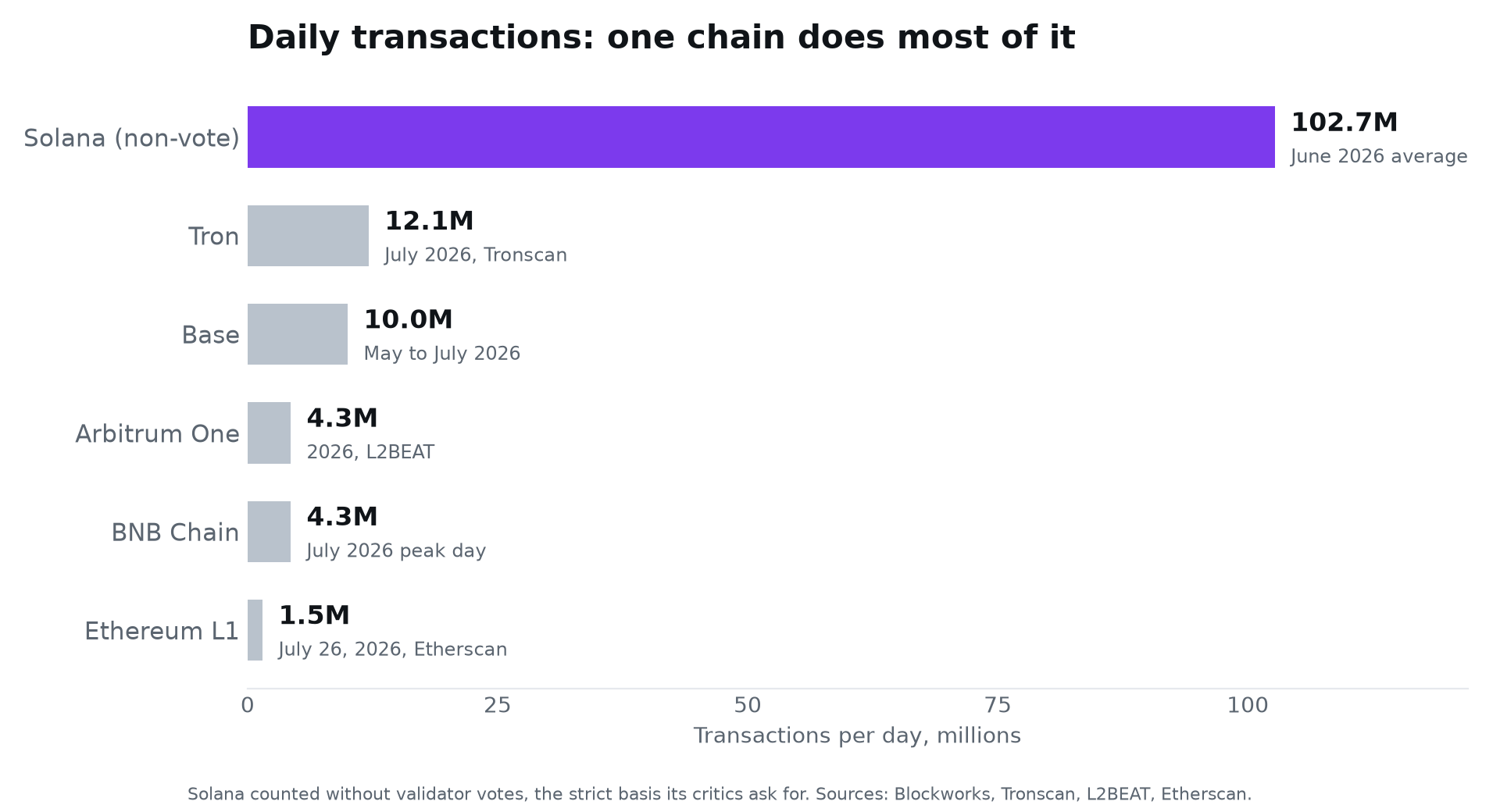
Chart data: daily transactions by chain
| Chain | Daily transactions (millions) |
|---|---|
| Solana (votes excluded) | about 103 |
| Tron | 12 |
| Base | 10 |
| Arbitrum | about 4 |
| BNB Chain | about 4 |
| Ethereum L1 | 1.5 |
Everything else is an order of magnitude down. Ethereum's L1 settles about 1.5 million transactions a day. Tron, the workhorse of offshore dollar transfers, does about twelve million. Base and Arbitrum, the largest of Ethereum's L2s, run four to ten million each. Put the majors together and they do not reach Solana's number: in June 2026 Solana alone was about 56 percent of non-vote transactions across the chains the aggregators track, and a live Chainspect snapshot as I write this shows roughly 1,100 transactions per second on Solana against roughly 725 for the next ten chains combined. The margin moves day to day, and a share of any high-throughput chain's count is bots and failed spam, which belongs in the caveats. It does not change the shape. One chain does most of it.
Addresses tell the same story from the other side: Nansen's July snapshot put Solana at about 29.8 million weekly active addresses, more than Tron, BNB Chain, Bitcoin and Ethereum combined. And on the exchange side, Birdeye's H1 report gives Solana 54 percent of global spot DEX volume. Whatever you think the activity is worth, it is where the activity is.
The companies are already on it
Usage would mean little if it were all internal to crypto. It is not, and the names involved are the least crypto-flavoured imaginable.
Western Union launched USDPT, its dollar stablecoin issued by Anchorage Digital Bank, on Solana in May, settling between Western Union and its agents first, with a consumer product planned in forty-plus countries. Fiserv picked Solana for FIUSD, a stablecoin aimed at its ten thousand financial-institution clients and six million merchant locations. Visa settles with US banks in USDC over Solana, with Cross River Bank and Lead Bank first in line, after having routed USDC settlement to acquirers over Solana since 2023. PayPal put PYUSD on Solana in 2024, and by this spring roughly 60 percent of PYUSD's supply lived there. Stripe's stablecoin accounts list Solana among their settlement chains, and Shopify merchants have taken USDC through Solana Pay since 2023. SoFi launched SoFiUSD on Solana in May, reported as the first stablecoin from a US nationally chartered bank. On the asset side, BlackRock's BUIDL and Franklin Templeton's on-chain money fund both trade share classes there, Societe Generale's FORGE issues its USD stablecoin there, and R3 is wiring Corda's regulated institutions into it. MoneyGram runs a validator. Korea's Toss Bank signed with the Solana Foundation to test remittance rails for its fifteen million customers.
One name deserves precision, because I nearly got it wrong myself. X Money, the payments product inside X, launched its wide US rollout in July on ordinary fiat rails: FDIC-insured accounts at Cross River Bank and a Visa debit card, no blockchain in the announcement. The Solana connections are adjacent and real: Cross River, the bank holding X Money deposits, is one of the first banks settling with Visa in USDC over Solana, and X's Cashtags feature pulls Solana market data through Helius, Birdeye, Jupiter and Dialect. The distance between "the bank behind X Money settles on Solana" and "X Money runs on Solana" is exactly the kind of distance this article tries to keep measured.
The product is the speed
A payments rail has three properties a buyer feels: what it costs, how fast it is final, and whether it is up. Here the comparison stops being close.
Solana produces a block roughly every 400 milliseconds and reaches full finality in about 12.8 seconds today, at a base fee of five thousandths of a cent per signature; the average fee actually paid, priority tips and bot traffic included, is about six tenths of a cent. Ethereum produces a block every 12 seconds and reaches economic finality in two epochs, about 12.8 minutes, at a median fee of a few cents. The symmetry of the two 12.8s is a coincidence, but it is a useful one: Solana finalizes in seconds what Ethereum finalizes in minutes, sixty times apart.
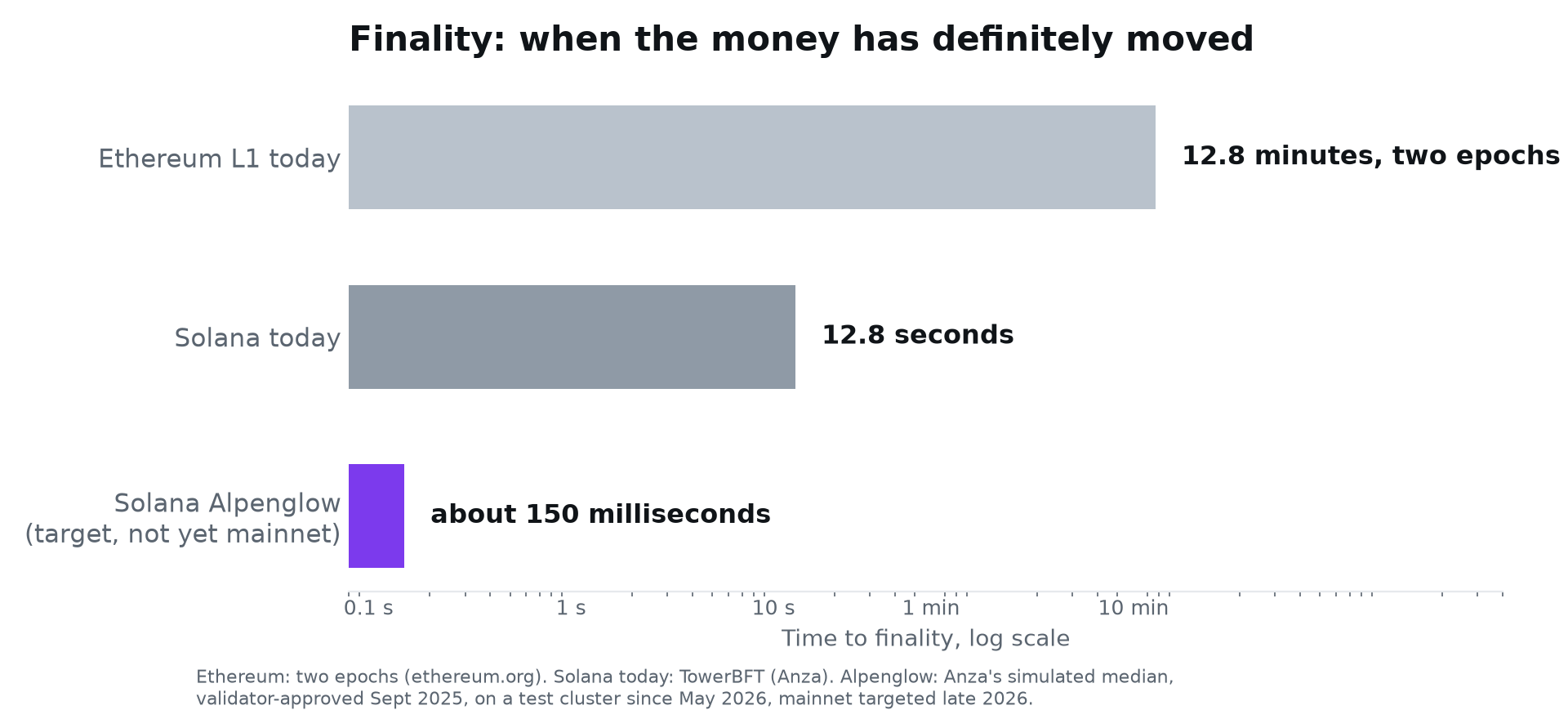
Chart data: time to finality
| Network | Time to finality |
|---|---|
| Ethereum L1, today | 12.8 minutes |
| Solana, today | 12.8 seconds |
| Solana with Alpenglow (simulated target) | about 150 milliseconds |
And that is the version of Solana that is about to be replaced. Alpenglow, Anza's ground-up rewrite of the consensus layer, replaces the voting system and Proof-of-History entirely; its simulated median finality against the real mainnet stake distribution is about 150 milliseconds, and votes move off-chain, which also retires the vote-transaction asterisk above. It is not mainnet yet, and the article you are reading will not pretend otherwise: validators approved it with 98.27 percent of the vote in September 2025, it has been live on a community test cluster since May, and mainnet is targeted for late this year. Ethereum's own path to fast finality, three-slot finality inside the Lean Ethereum roadmap, is in the specification stage, years from production. If both roadmaps land on schedule, one chain finalizes payments in the time a keystroke takes, and the other finalizes them in the time a pop song takes, and that gap holds to the end of the decade.
For a human tapping a card, 12 seconds against 12 minutes is an inconvenience ranking. For a machine holding state open while a request waits, finality is the product. An agent that pays for an API call, a data licence, a compute burst, needs the payment settled before the response streams, and there is exactly one rail today where "settled" and "before the response" belong in the same sentence, with an upgrade in test that turns the sentence into an afterthought.
Where the demand is forming
Four kinds of dollars are converging on the same rail, and they are the four this blog cares about because two of them are the previous article's whole subject.
Regulated dollars. Stablecoin supply on Solana crossed $16 billion this summer, and February set the monthly transfer record at $650 billion by Artemis's count. More telling than the totals is who issues the new coins: Western Union, Fiserv, SoFi, Societe Generale, PayPal. Those are not crypto natives choosing a chain by ideology; they are settlement engineers choosing by throughput, cost and finality.
Tokenized assets. Real-world assets on Solana quadrupled in the first half to a record $3.62 billion, BlackRock's BUIDL the single largest position, and the tokenized-stock market effectively lives there: in July Solana processed about $1.45 billion of tokenized-equity spot trading, roughly 82 percent of the month's total across every chain, per Blockworks. The whole tokenized market outside stablecoins is only about $30 billion today, which is precisely why the banks' own forecasts matter: McKinsey sees $2 to $4 trillion by 2030, Citi's June report puts the base case at $5.5 trillion (PDF), BCG and Ripple $9.4 trillion, Ark $11 trillion, Standard Chartered $30 trillion by 2034. If any fraction of that lands on the chain already clearing most tokenized-equity volume, today's numbers are a rounding error of what follows.
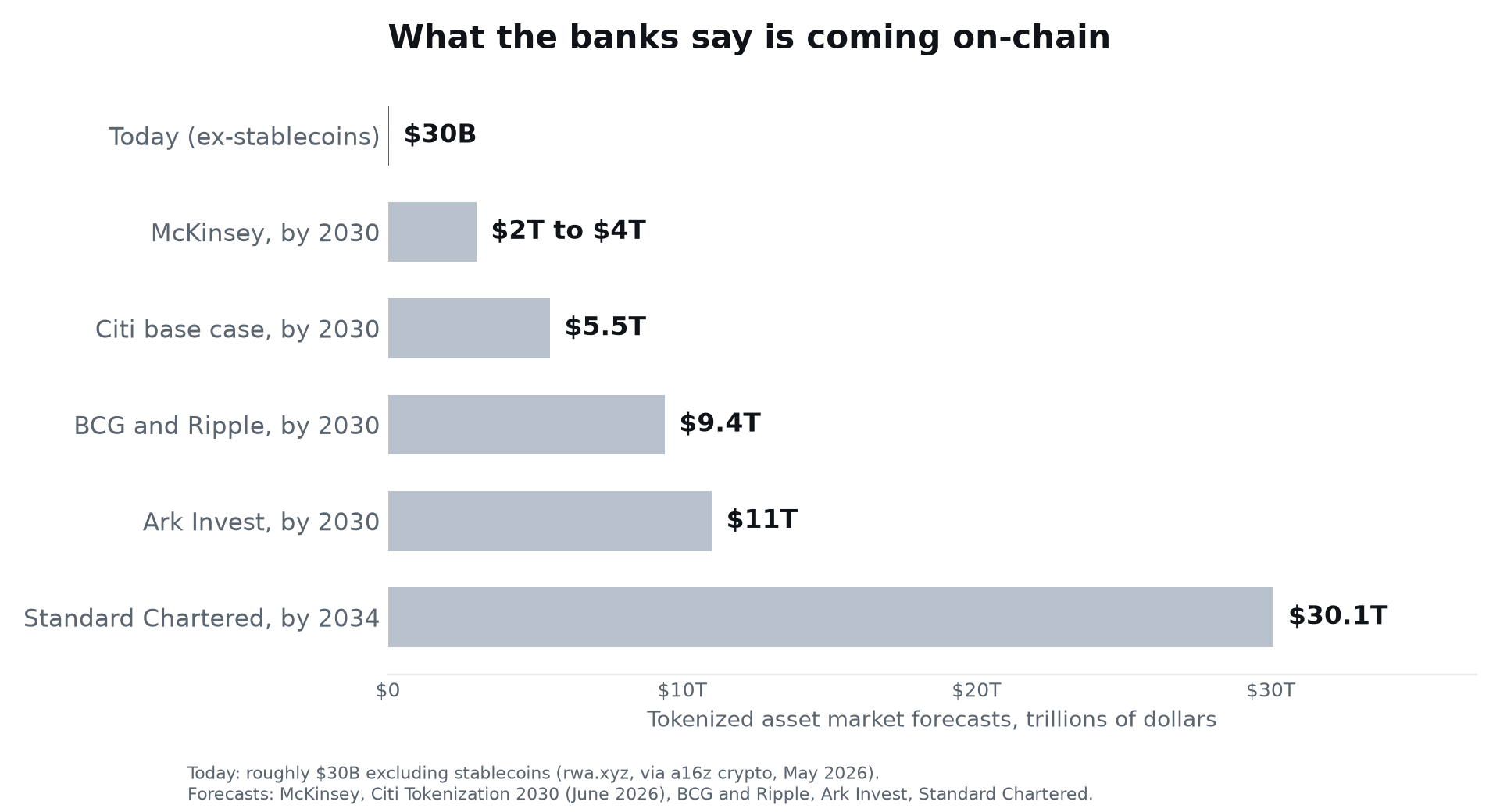
Chart data: tokenization forecasts
| Source | Tokenized market value |
|---|---|
| Today (outside stablecoins) | about $30 billion |
| McKinsey, by 2030 | $2 to $4 trillion |
| Citi, base case of the June report | $5.5 trillion |
| BCG and Ripple | $9.4 trillion |
| Ark Invest | $11 trillion |
| Standard Chartered, by 2034 | $30 trillion |
Machine buyers. The 402 exchange my agent demo spoke is no longer a niche: x402, the standard Coinbase launched around the dormant HTTP status code, now sits under the Linux Foundation with Visa, Mastercard, Google, Microsoft, Amex, Stripe, Shopify and the Solana Foundation among its members, and its second version added hooks for card networks and bank rails as settlement legs. It settles on Solana mainnet today, where the Foundation counts 35 million x402 transactions so far. Kept measured: Chainalysis notes Base still hosts the most active deployment cumulatively, Solana takes the lead only in some weekly windows, total x402 dollar volume is still tiny against any card network, and a chunk of last autumn's surge was memecoin farming rather than agents at work. The direction is what matters: the card networks themselves, through Visa's Intelligent Commerce and Mastercard's Agent Pay, are building for buyers that are software, and the settlement layer they keep touching is stablecoins on fast chains.
Consumers, described accurately. The biggest consumer activity on Solana is still speculation: memecoin trading is about 42 percent of its DEX volume, and Pump.fun alone took $124.7 million in revenue in the first quarter. DePIN networks like Helium are real and growing and small in revenue terms. I am not going to dress that up: the casino is load-bearing for today's numbers. What the casino proved, though, is that the rail holds a hundred million transactions a day without falling over, which is the stress test every payments engineer wanted run at somebody else's expense.
Why the price disagrees, in James's reading
Against all of that, SOL trades around $74 as I write, down roughly 70 percent from its 2025 high. Usage at record highs, price at multi-year lows. I wanted a considered explanation of that gap, and the most data-driven one I follow comes from InvestAnswers, the 577,000-subscriber channel run by James, a former hedge fund manager and data scientist who is careful to say, in every video description, that he is not a licensed financial advisor and shares his positions as learning examples. What follows is his reading, credited as such, not mine and not advice; my article's own claims end at the usage data above.
In his May analysis of Solana against Ethereum, he calls the gap "classic adoption lag, where the market prices narrative before usage", and his slides put the rest bluntly: Solana has the usage now, the way Amazon had the metrics while the market ignored them; retail is still traumatized from 2022; institutions are slow to allocate; catalysts are stacking, Alpenglow among them; and on-chain data does not lie. One of his chapter titles is where the section above got its argument: in an agentic world, finality is the product.
He has also walked through a more aggressive framework than his own: the Digital City model published by DeFi Development Corp, the Nasdaq-listed Solana treasury company, which values the network like a city economy rather than a company. Its arithmetic: roughly 90 percent of SOL supply is structurally committed in staking, DeFi, institutional custody and application reserves, leaving about 75 million SOL of genuine float, and dividing the model's $752 billion of projected exogenous demand by that float implies a five-figure SOL price. James's own stated target is far more conservative, $2,000 to $3,000 by the early 2030s. And the market's counterweight deserves its line: DFDV itself, the company publishing the model, trades at roughly 0.4 times the value of its own SOL treasury, which is the market pricing deep scepticism about everything in this paragraph. Adoption lag and scepticism are the same chart read in two directions; one of them will turn out to have been right, and this article is not the one that settles it.
How payments work in the era of AI
Here is where the two articles join.
The guild I built pays 40,000 members weekly, two million payments a year, for $51 of settlement on Solana; the same job priced on PayPal's published sheet is about $499,000 a year, and on Stripe Connect about $1.3 million, most of it per-account fees. That is not a discount, it is a different category of thing, and it is why the payout system in that article could exist at all. A royalty of eleven cents is not payable on a rail that costs thirty cents to move money; it is trivially payable on one that costs a fortieth of a cent.
And the buyer side is harder than the seller side, because the buyer might not be a legal person. An agent cannot hold a bank account, pass a KYB onboarding, or sign a card agreement. It can hold a key, read a 402, pay a stablecoin invoice and prove it did. Every serious actor now agrees on that shape: Coinbase built the standard, the Linux Foundation governs it, Visa and Mastercard joined it while building their own agent layers on top, and the banks are issuing the dollars those agents will spend, on the chain this article has been counting.
Security points the same way, against the common intuition. A bank is online by construction, staffed by people who answer phones, and the day before this article went out, a wave of AI-powered voice-phishing attacks on Citadel, Point72 and Two Sigma was reported, employees talked toward granting system access by synthetic voices, with Two Sigma saying it blocked its attack and found no breach. AI is making the oldest attack, a convincing voice asking to be let in, cheap at industrial scale, and it works precisely on institutions whose systems and people must stay reachable to function. A chain done well inverts the exposure: the key that moves the money can be generated on a hardware wallet that has never touched the internet and can sign without ever touching it, so there is no phone line into the vault and no employee whose credentials open it. Custody done badly loses money on a chain too, and phishing hunts wallet holders as readily as bank staff; the difference is the ceiling, because a bank cannot take itself offline and a key can live offline permanently. The previous article made the other half of this point with Banco Espírito Santo: on the bank rail, the institution's word is the evidence, and Portugal learned in 2014 what a word can be worth.
So my claim is narrower than a price target and sturdier: whatever SOL is worth, the work has already moved. The transactions are there, counted strictly. The corporates are there, by press release, with dates. The speed is there today and about to improve by two orders of magnitude, while the alternative's roadmap measures the same journey in years. The machines that buy will not care what the coin trades at; they will care that the payment clears while the request waits, costs less than the thing it buys, and leaves a receipt anyone can verify. On the day my agent stops settling against a demo balance and starts paying for real, I already know which rail it pays on.
If you are building agents that buy, or payouts too small for the rails you have, the numbers above are the homework I wish someone had handed me. The sources are all one click deep.
Questions this article answers
Which chain will AI agents actually pay on?
Solana, on the evidence available today. x402, the standard Coinbase built around the dormant HTTP 402 status code and now governed by the Linux Foundation with Visa, Mastercard, Google, Stripe and Shopify among its members, settles on Solana mainnet, where the Foundation counts 35 million x402 transactions so far. An agent cannot hold a bank account, pass a KYB onboarding or sign a card agreement, but it can hold a key, read a 402, pay a stablecoin invoice and prove it did.
Is Solana's transaction count just bots and memecoins?
Partly, and the article says so rather than dressing it up: memecoin trading is about 42 percent of Solana's DEX volume, Pump.fun took $124.7 million in revenue in the first quarter, and a share of any high-throughput chain's count is bots and failed spam. The counts here already drop validator votes, the strictest basis the chain's critics ask for, and Nansen put weekly active addresses at about 29.8 million, more than Tron, BNB Chain, Bitcoin and Ethereum combined. What the speculation proved is that the rail carries a hundred million transactions a day without falling over, which is the stress test every payments engineer wanted run at somebody else's expense.
Why is SOL's price down if usage is at record highs?
This article does not settle that, and says as much. The most data-driven reading it credits belongs to James of InvestAnswers, who calls the gap classic adoption lag, where the market prices narrative before usage, with retail still traumatized from 2022 and institutions slow to allocate. The counterweight is priced too: DeFi Development Corp, the Nasdaq-listed company publishing the five-figure Digital City model, trades at roughly 0.4 times the value of its own SOL treasury.
How much does it cost to pay out tiny amounts this way?
Paying 40,000 guild members weekly, two million payments a year, costs $51 of settlement on Solana. The same job priced on PayPal's published sheet is about $499,000 a year and on Stripe Connect about $1.3 million, most of it per-account fees. A royalty of eleven cents is not payable on a rail that costs thirty cents to move money, and is trivially payable on one that costs a fortieth of a cent.
Read next
 Embodied AI
Who Owns the Work That Teaches the Machines?
Embodied AI needs footage of skilled hands doing real work, and the people producing it are giving it away. Musk says the robots end with money irrelevant; Leo XIV says surviving is not participating. Between those two claims sits a long transition, and this is a working system for holding a stake in it: a guild that pays a share, measured against the real Solana runtime. Numbers included, and not all of them flatter the idea. AI
AIWhen the AI Has to Film Its Own Review
When a pull request is raised, mine or one I have to review, I now ask the agent to run it on my machine, try to break it and film itself doing it. A paragraph can claim a test happened. A recording has to show it, and deciding what it means is still my job.