
Who Pays When the AI Is Wrong? I Read Ten Vendors' Terms to Find Out
Listen to this article (experimental) · 13:02

Here is a simple question to ask any tool you are about to trust with something that matters: if you are wrong, and being wrong costs me something, who pays?
Ask a structural engineer and the answer is: their professional liability insurance, their licence, and in bad cases their freedom. Ask an accountant: their indemnity cover and their signature on the filing. Ask an airline: a regulation with compensation amounts printed in it. This is not a detail of those professions — it is close to the definition of a profession: someone who answers for the answer.
Now ask an AI assistant. Better: ask the contract behind it, because the contract is where the honest answer lives. In the synthesis essay I argued that recourse — an enforced no, and a person who answers when things go wrong — is one of the four places value moves when machines make production cheap. So I spent a few days reading the current consumer terms of service of ten AI vendors: OpenAI, Anthropic, Google, Microsoft, Meta, xAI, Mistral, Perplexity, Midjourney, and GitHub Copilot. All quotes below are from the versions in force as I write (I note effective dates; terms change, and some clauses' enforceability varies by jurisdiction — more on that at the end).
The short version: all ten contracts make the same four moves, in roughly the same order, like a dance everyone's lawyers learned at the same academy.
Move one: nothing is promised
Every single one of the ten opens the liability section with the same incantation, usually in capital letters, which in contract law is how you shout: AS IS.
OpenAI (terms effective January 1, 2026): "OUR SERVICES ARE PROVIDED 'AS IS.'" Anthropic: "THE SERVICES AND OUTPUTS ARE PROVIDED 'AS IS' AND 'AS AVAILABLE' WITHOUT WARRANTY OF ANY KIND." Meta: AIs and outputs come "on an 'as is' and 'as available' basis," with no guarantee they will be "safe, secure, or error-free." Microsoft's Services Agreement (effective September 30, 2025) commits to the genre's masterpiece: the services come "'AS IS' 'WITH ALL FAULTS' AND 'AS AVAILABLE'" — and then, in a sentence I have read six times to make sure it exists: "YOU BEAR THE ENTIRE RISK OF USING THE SERVICES."
Two vendors deserve honorable footnotes. Google actually gives an affirmative warranty — "We provide our services using reasonable skill and care" — before disclaiming most of the rest, and Mistral warrants that its products will materially conform to their documentation before the block capitals begin. These are real, if modest, promises, and in a genre this bleak, modest promises stand out like lighthouses.
Move two: the verification duty is yours now
The second move is more interesting than the first, because it is not just a shield — it is a transfer. Every contract tells you, in surprisingly plain language, that the product's defining risk is real, and that managing it is your job.
OpenAI: "Output may not always be accurate. You should not rely on Output from our Services as a sole source of truth or factual information, or as a substitute for professional advice." Anthropic, with a phrase I genuinely admire for its honesty: outputs "may contain material inaccuracies even if they appear accurate because of their level of detail or specificity" — the contract-law rendering of confidently wrong. xAI's terms (effective April 10, 2026) are the only ones brave enough to use the industry's own word: output "may sometimes... result in Output that contains 'hallucinations.'" Mistral, sweetly: "Mistral AI Products are not authoritative or infallible sources of information... always verify the reliability, accuracy, and completeness of the Output." GitHub, for Copilot: "You are responsible for reviewing, testing, and validating any Output before use."
And then there is Microsoft's supplemental Copilot AI Experiences terms, which contain the single most clarifying sentence in this entire research project: "The Online Services are for entertainment purposes."
Read that again, and then remember what these products are marketed for. The advertisement says: your doctor-adjacent, lawyer-adjacent, analyst-adjacent assistant. The contract says: entertainment; verify everything; professional advice sold separately, by professionals, who — see the opening of this essay — are professionals precisely because they carry the risk. In the Sparkling Water experiment I measured how a model that knows your record still can't know tonight's intention. The terms of service are the same finding wearing a suit: the vendor, who knows the model best, contractually declines to stand behind what it says.
Move three: the cap
So nothing is warranted and you must verify everything — but suppose the worst happens anyway. The product is wrong, you relied on it, and it cost you real money. What does the vendor owe you? Every contract names a number, and the numbers are the funniest documents in software.
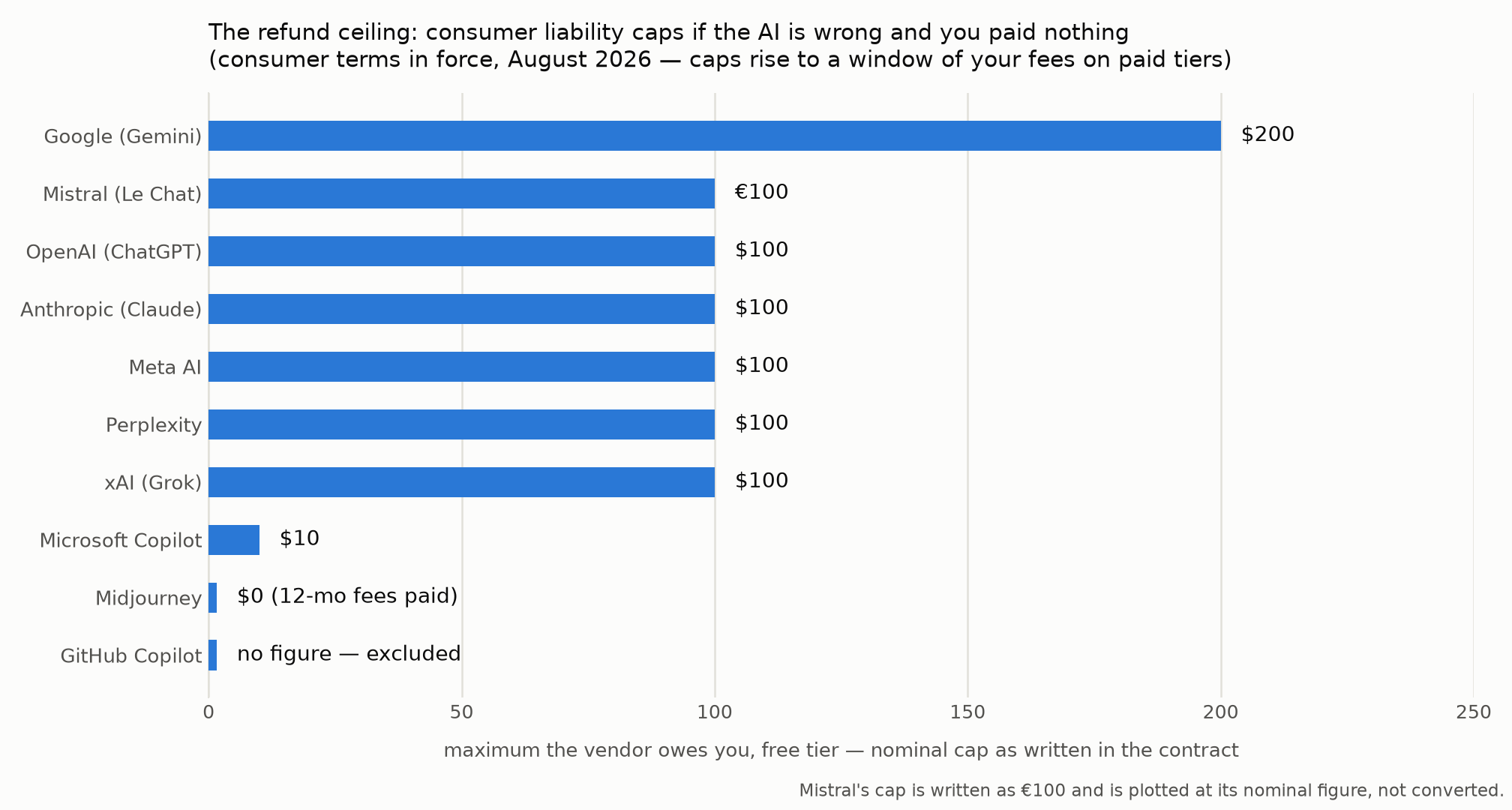
Chart data: free-tier liability caps
| Vendor | Cap on a free tier |
|---|---|
| GitHub | $0 (no figure named; the listed damages are excluded) |
| Midjourney | $0 (what you paid in the last twelve months) |
| Microsoft | $10 (if the Services are free) |
| OpenAI | $100 (the greater of $100 or twelve months of payments) |
| Anthropic | $100 (the greater of $100 or six months of payments) |
| xAI | $100 (the greater of $100 or whatever you paid) |
| Meta | $100 (the greater of $100 or twelve months of payments) |
| Perplexity | $100 (the greater of $100 or six months of payments) |
| Mistral | €100 |
| $200 |
On a free tier — which is how most of humanity uses these tools — the caps line up like this. GitHub's terms name no dollar figure at all: the listed damages are simply excluded, so the practical answer is zero. Midjourney caps at what you paid in the last twelve months, which on a free trial is also zero. Microsoft: "up to $10.00 if the Services are free" — ten actual dollars, about ten coffees where I live, for anything Copilot may have done to you in a month. OpenAI, Anthropic, xAI, Meta and Perplexity settle at the greater of $100 or some window of your payments (twelve months for OpenAI and Meta; six for Anthropic and Perplexity; xAI, whatever you paid). Mistral, being French, caps at €100. And the most generous consumer liability ceiling in artificial intelligence, the summit of the industry's confidence in its own products, is Google's: two hundred dollars.
Every one of these sits next to a consequential-damages exclusion — no lost profits, no lost data, no downstream anything, "EVEN IF WE HAVE BEEN ADVISED OF THE POSSIBILITY OF SUCH DAMAGES." The structure is worth saying plainly: the industry that tells investors its products will transform medicine, law, and engineering tells its users, in writing, that being wrong is worth at most the price of a nice dinner, and usually less.
Move four: you insure them
The fourth move is the one almost nobody reads far enough to find, and it is the one that inverts the whole question. You came to the contract asking who pays me if the AI harms me? The contract answers a different question: you pay us if your use of the AI harms us.
Indemnification clauses — you agree to cover the company's losses and legal fees for claims arising from your use — appear in most of the ten. Anthropic's consumer terms have one. Perplexity's is standard-issue. Midjourney's covers claims "arising out of or relating to your use of the Services and Assets." GitHub's applies expressly to AI output you incorporate into your products. And xAI's is the broadest thing I found in forty-odd pages of legal text: you indemnify them against claims "arising from or related to your use of the Service and Output" — not your misuse, not your breach: your use. The machine generates a paragraph; you use it; if a third party sues over it, the contract's answer is that you will defend the machine's maker.
So the full recourse picture, assembled: the product is warranted for nothing, the duty to catch its errors is yours, its maker's exposure is capped near the price of a paperback per incident — and in several cases you are the insurer of last resort for them. As an answer to "who answers when it's wrong?", the modern AI contract is a small masterpiece of misdirection. The answer is you. It was always you. You are the recourse.
Where the real answers are (and what they cost)
Two more findings, and they matter more than the comedy.
First: when you do get a promise, notice who gets it. OpenAI's business terms include IP indemnification — OpenAI defending the customer — that its consumer terms do not. Meta's business AI terms contain the indemnity clause its consumer AI terms lack. And Mistral, to its genuine credit, indemnifies even ordinary users against third-party IP claims over its products — the only vendor of the ten whose consumer terms contain a promise flowing in that direction. The pattern is the thesis of the recourse address in one sentence: accountability exists; it is sold separately, and it is priced. Enterprises negotiate real indemnities because enterprises have lawyers who ask my opening question before signing. Consumers click "I agree."
Second: the dispute machinery is arranged before you arrive. OpenAI, Microsoft and Perplexity require binding arbitration with class-action waivers (OpenAI and Perplexity offer a 30-day opt-out — a letter almost nobody sends). Midjourney requires arbitration where each side pays its own lawyers regardless of who wins — on a $200 dispute, that clause is the dispute. xAI skips arbitration but takes your jury and your class action, and moves everything to specific courts in Texas, with a one-to-two-year deadline to sue. Anthropic is a notable outlier — no arbitration clause and no class-action waiver in its consumer terms, plain San Francisco courts — as are Google, Meta, Mistral, and GitHub. When the front door (warranty) is welded shut, the shape of the back door (procedure) tells you how often anyone is expected to try it.
The necessary honesty paragraph: these are the US-facing consumer documents, quoted from the versions effective on the dates given, and they are the vendors' opening position, not the last legal word. Consumer-protection law in much of the world limits how far "AS IS" can actually stretch — Meta's own EU terms drop the $100 cap entirely and accept unlimited liability for intent and gross negligence, which tells you the caps are a choice, not a physical constant. Courts will eventually decide how these clauses hold up against a product that speaks in confident first-person sentences. But the documents are still the truest available statement of what the makers believe their products' words are worth, expressed in the only language that compounds: money.
The address still stands
None of this is a scandal, exactly. Startups cannot underwrite unbounded liability for a technology that hallucinates; the lawyers are doing their jobs; I would write similar terms if I shipped a general-purpose text machine to a billion strangers. That is precisely the point. The caps are not a bug in the industry — they are the industry telling you, accurately, what a machine's answer is: a probabilistic artifact that nobody stands behind, produced at a marginal cost of almost nothing, warranted for exactly that amount.
Which is why recourse is an address where value lives and will keep living. Whatever a machine can make gets cheap — and here are ten contracts confirming that what no machine's maker will do is answer for it. The professional who signs, the firm that carries insurance, the vendor who says "if this is wrong, we make you whole" — their scarcity is now written into forty pages of block capitals, priced between ten dollars and two hundred. When someone finally sells real accountability for machine output at consumer scale, they will be selling the rarest thing in this market. Until then, read the terms, and know exactly what you were always going to be: the person who answers.
Questions this article answers
If an AI tool gives me bad information and it costs me money, can I claim anything back?
Very little, and on a free tier usually nothing. GitHub's terms name no figure and simply exclude the listed damages, Midjourney caps at what you paid in the last twelve months, Microsoft caps at ten dollars if the service is free, and the highest consumer ceiling found across the ten vendors is Google's two hundred dollars. Every cap sits beside a consequential-damages exclusion, so lost profits and lost data are out even where a number exists.
Do AI terms of service make me responsible for what the model generates?
In most of the ten, yes, through the indemnification clause that few readers reach. You agree to cover the company's losses and legal fees for claims arising from your use, and xAI's is the broadest of the set because it reaches claims related to your use of the Service and of the Output, not your misuse or your breach. GitHub's applies expressly to AI output you incorporate into your own products.
How do I get a vendor to actually stand behind AI output?
You buy it. OpenAI's business terms include IP indemnification that its consumer terms do not, and Meta's business AI terms contain the indemnity clause missing from the consumer version, because enterprises have lawyers who ask who pays before signing. Mistral is the one exception at consumer level, indemnifying ordinary users against third-party IP claims over its products.
Aren't these caps just standard legal boilerplate that a court would never enforce?
They are the vendors' opening position rather than the last legal word, and consumer-protection law in much of the world limits how far a disclaimer can stretch. But the caps are still a choice, not a physical constant: Meta's own EU terms drop the hundred-dollar cap entirely and accept unlimited liability for intent and gross negligence. The documents remain the truest available statement of what the makers believe their products' words are worth, expressed in money.
Read next
 AI
AIJev Answers in Probabilities. The Question Is Still Yours.
TypeSafe's Jev will not write a sentence. You hand it a state and typed questions, and it hands back a choice, a score or a yes/no probability, at four thousandths of a cent for a decision over a thousand tokens. The novelty is the shape, which puts authority back in your code, and the trap is that a probability looks like recourse and is not. I ran the pilot I would want before believing any number, on my own essays with the open model that stood in for Jev, and the answer was no. AI
AIWhen the AI Has to Film Its Own Review
When a pull request is raised, mine or one I have to review, I now ask the agent to run it on my machine, try to break it and film itself doing it. A paragraph can claim a test happened. A recording has to show it, and deciding what it means is still my job.