
Scratch, Veto, Go: Two Evenings That Almost Didn't Happen
Listen to this article (experimental) · 12:51

There is a moment most evenings have, and nobody has named it. Dinner is done. The kitchen is more or less recovered. It is half past eight, the night is technically young, and two people who genuinely like each other are standing in the living room holding their phones like life vests. Someone says "what do you want to do?" and someone answers "I don't know, what do you want to do?" And that exchange, repeated three times, is how a free evening quietly becomes no evening at all.
In the synthesis essay I argued that attention is one of the four places value moves when machines make everything else cheap: demand for your evenings has multiplied, and the supply is fixed. The feeds have solved "what do you want to do?" with an answer that is always available, never wrong, and never memorable. I wanted to build the opposite answer. So I built RotinaTop, and rather than explain it like a product page, I want to show you two evenings with it. The people are composites; the app, the cards, and everything on the screens below are real.
What it is, in one paragraph
RotinaTop is a growing deck of adventure challenges (forty-eight today, twelve each for couples, families, kids, and friends, with more written as the need for them shows up) hidden under scratch-off foil, exactly like the paper scratch books it is modelled on. Before you scratch, a card shows you only its terms: cost (Free, $, $$), when it is best done (Before 7 PM, Before 9 PM, Any Time), how long it takes, and a few hint icons (outdoors, meal, car, mess). What the challenge actually is stays hidden until you drag the foil away. Once revealed, it is three steps, no more. Finish one, write down what happened, and it lands in a private memory feed nobody else can read. There is also a second deck, which works the other way round entirely. I will come back to it, because the difference between the two is the whole argument.
Vignette one: Tuesday, 20:34
Ana and Pedro, mid-thirties, married six years. The dishwasher is humming. Pedro is already half-horizontal on the sofa, thumb hovering over the app where evenings go to die. Ana opens the Couple deck instead and puts the phone between them on the counter: one screen, two heads, which is already a different geometry than two screens, two heads.
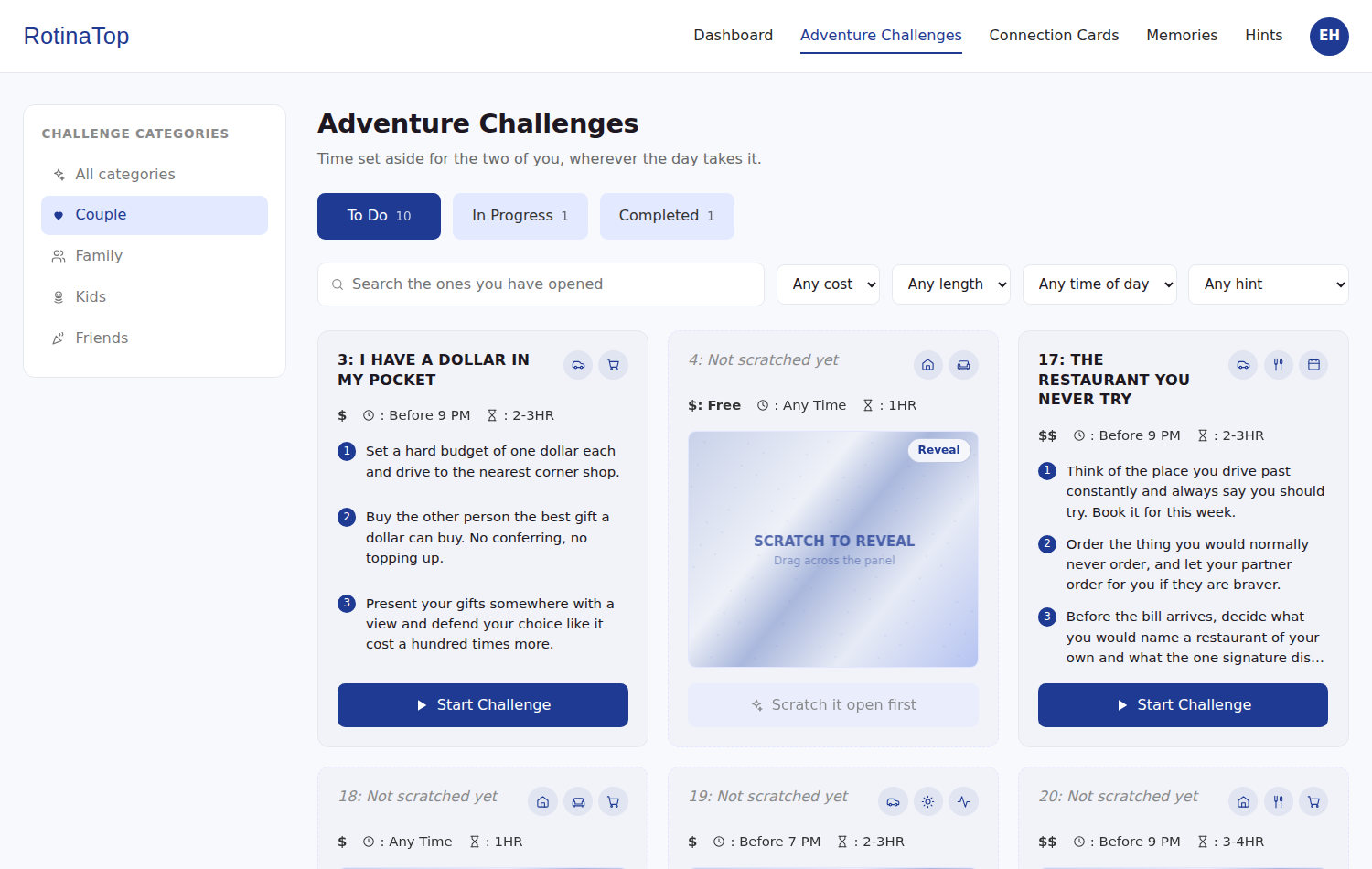
Ten cards they haven't opened, face down, each one telling them just enough. And this is where the first small mercy of the design kicks in: they get to veto without spending anything. Card 17 is already open from last month ("The Restaurant You Never Try"), lovely, but it is $$, Before 9 PM, and needs a booking; not tonight. Card 20 is $$ and three to four hours; vetoed at a glance. Card 18 has the little home icon. Pedro makes the executive ruling that they are not doing another night indoors, which for a man lying on a sofa is a heroic position to take. What survives the veto round is a face-down card that costs nothing, works any time, and wants two to three hours: exactly the shape of the evening they actually have.
Ana scratches. The foil comes away in strips under her thumb: a small, ridiculous, genuinely pleasing act that a tap could never replace.
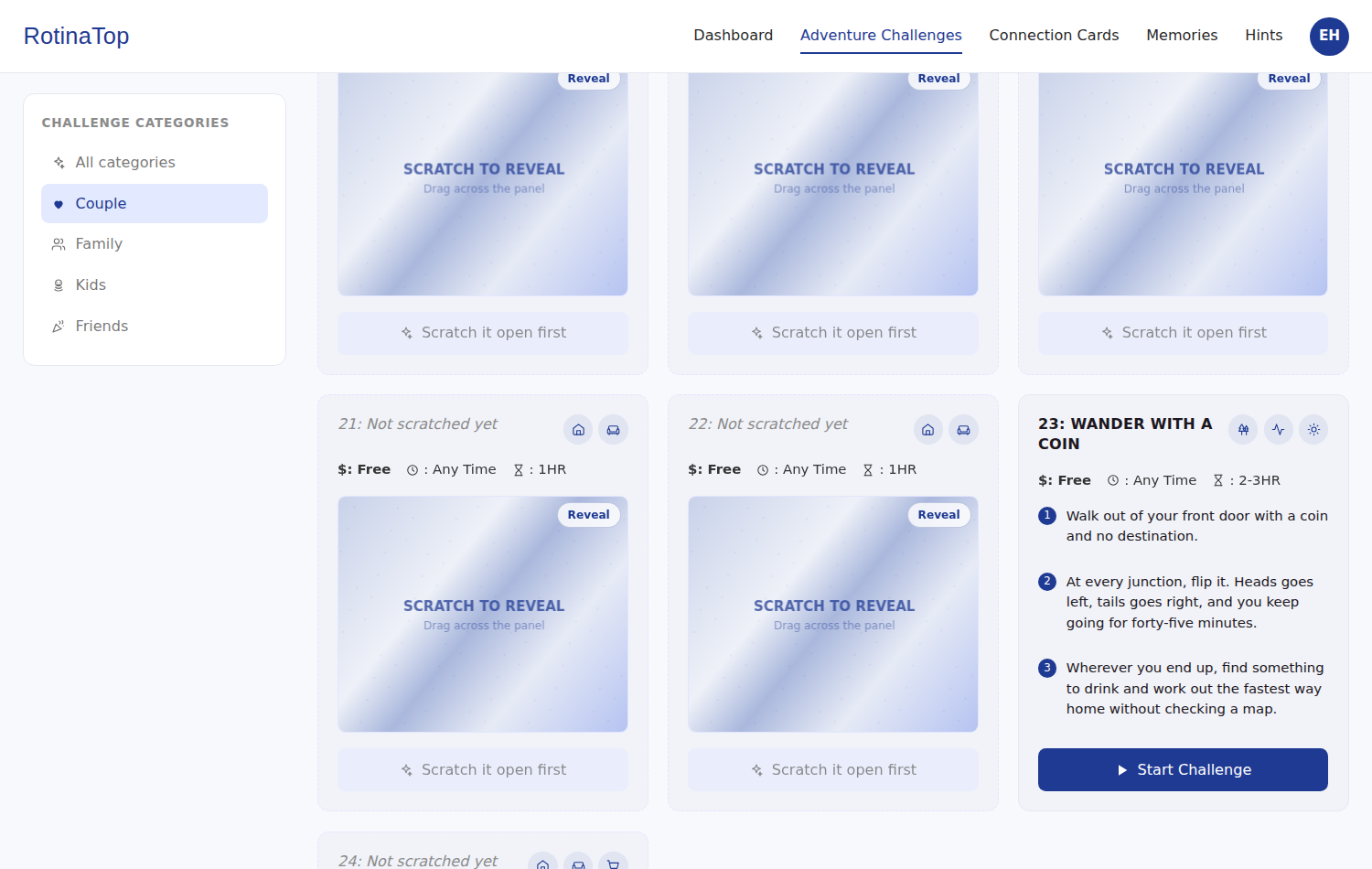
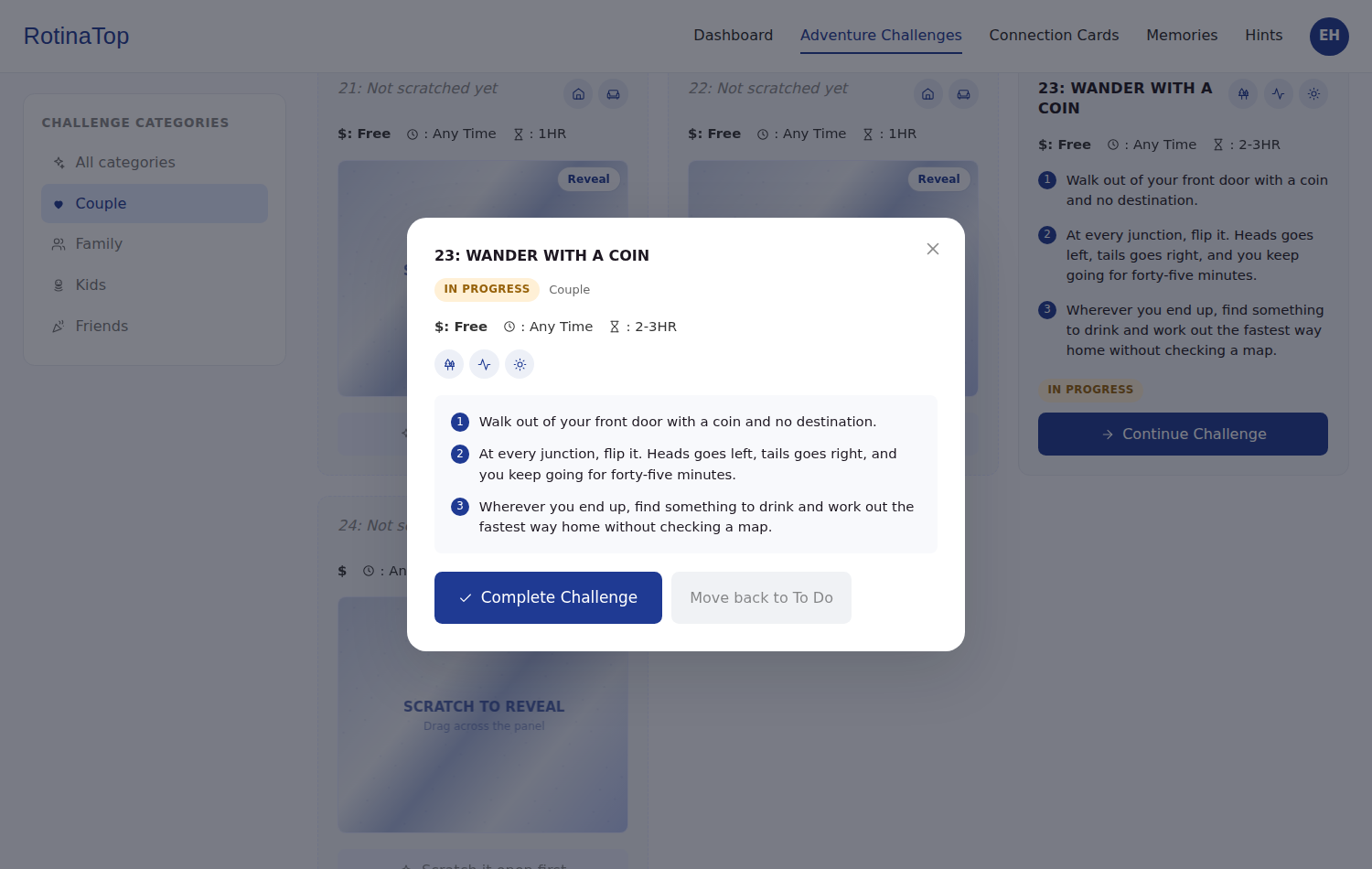
Wander With A Coin. Walk out of your front door with a coin and no destination. At every junction, flip it (heads left, tails right) for forty-five minutes. Wherever you end up, find something to drink and work out the way home without a map.
Pedro reads it twice and says the thing that every one of these cards is engineered to survive: "that's stupid." It is a little stupid. That is the point. Sixty seconds of negotiation later (the sunk cost of the scratch doing quiet work; you opened the card, it would be rude to waive it), they press Start Challenge, and the card moves to In Progress, where it will sit visibly, mildly accusing, until they either do it or formally surrender.
They go. The coin sends them left, left, right, left: away from their usual loop, down the alley they have walked past for four years. There is a little street market behind the church that neither of them knew existed. They drink lemonade on a bench that belongs to a stranger's front wall. Getting home without the map takes twenty minutes and two arguments, both enjoyable. At no point does either of them look at a feed.
Back home, the app asks one last thing: not a rating, not a share. What happened?
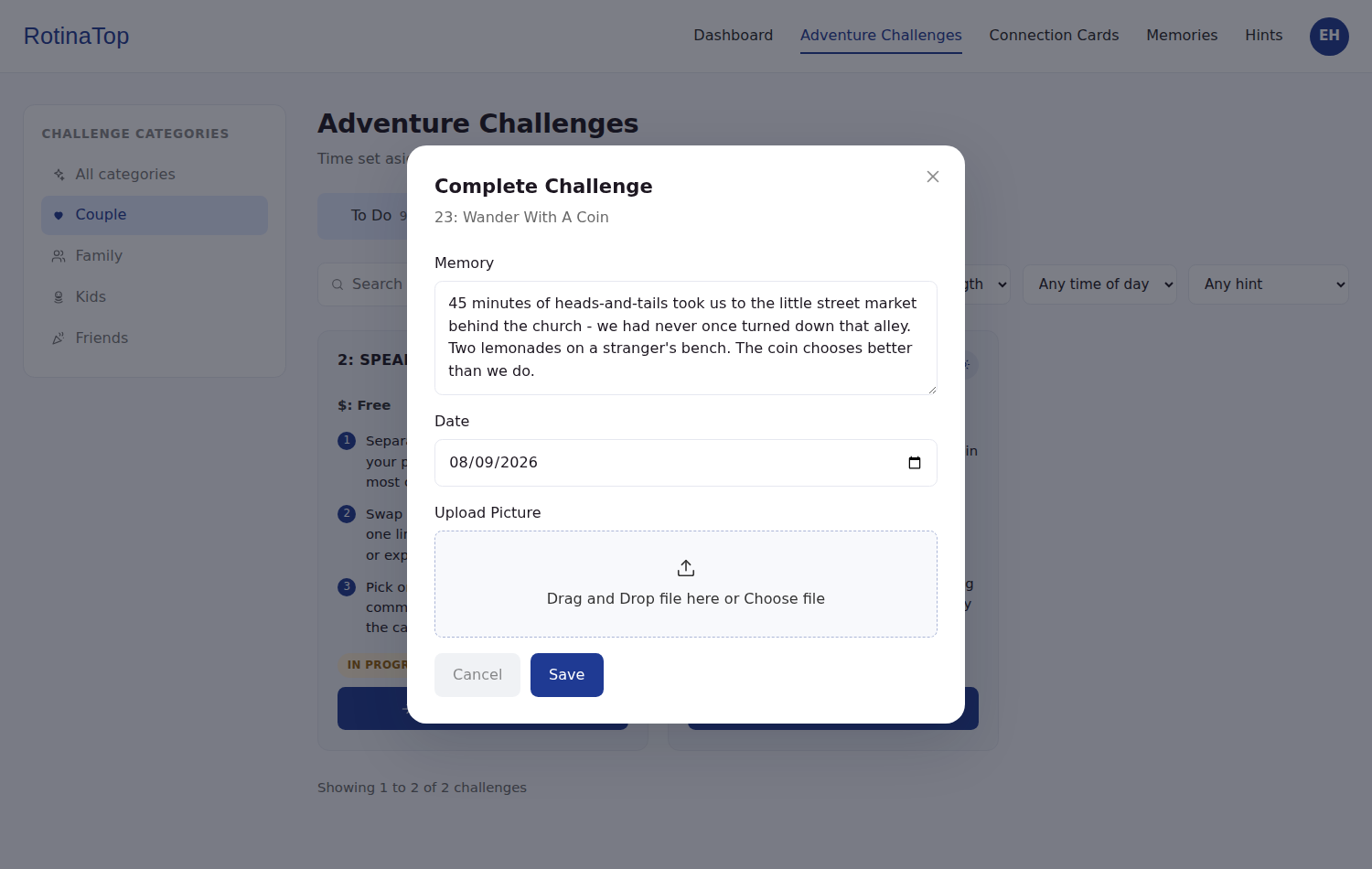
Forty words, typed with one thumb while the kettle boils. And this is the part I care most about: that memory goes into a feed that is private by construction. No likes, no followers, no audience to perform for. In an economy that wants to sell your evenings back to you as content, a diary that cannot be published is a small act of rebellion.
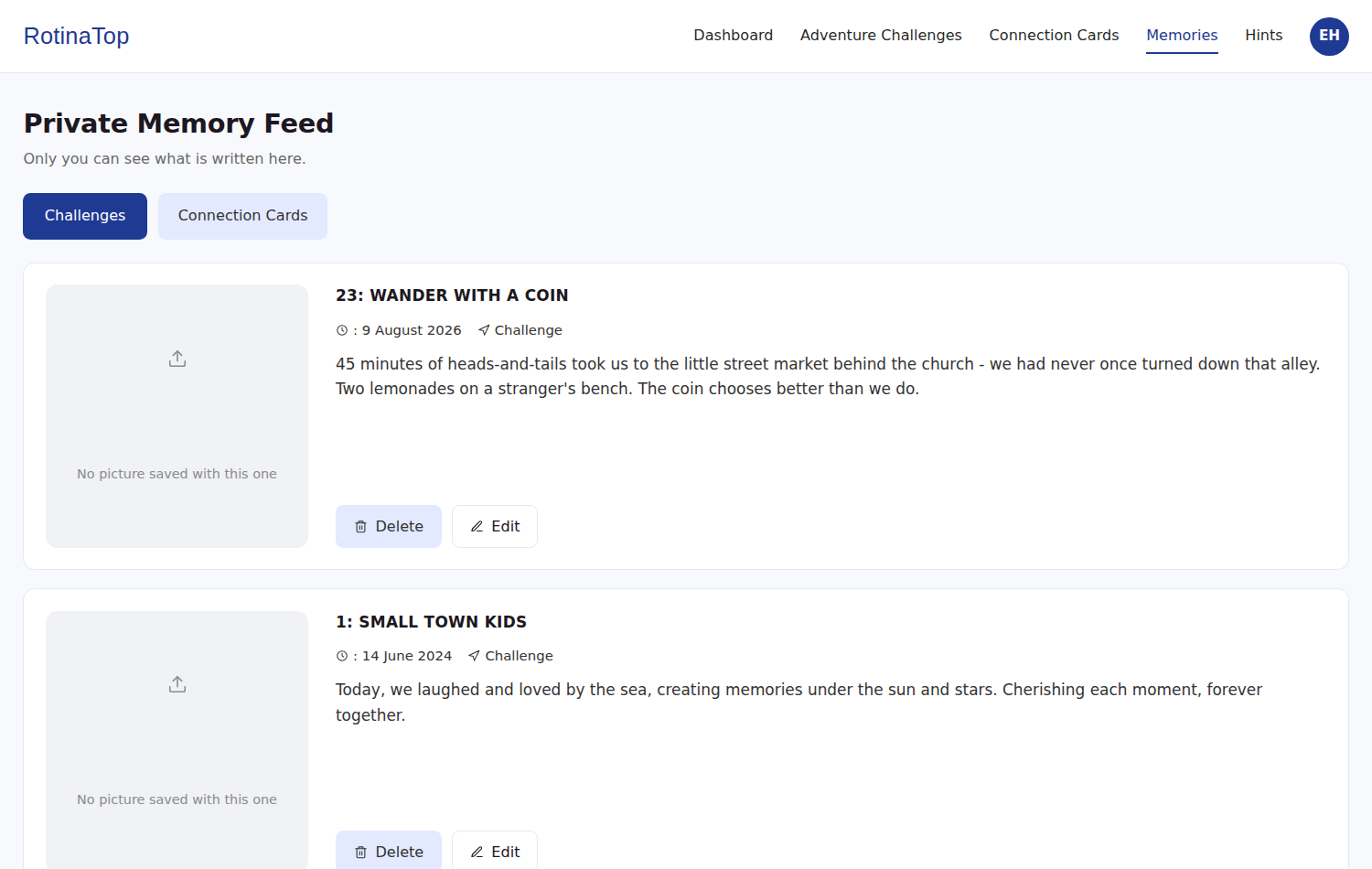
"The coin chooses better than we do," Ana writes. On the evidence, hard to argue.
Vignette two: Saturday, 10:15
The Costa family: two adults, a nine-year-old, a six-year-old, and a Saturday that is starting to dissolve. Cartoons on, tablets circling like gulls. The forecast is good and everyone can feel the day slipping toward the default: a bit of screen, a bit of snacking, that specific Saturday melancholy of having done nothing in particular, together, in the same house, separately.
The Family deck comes out over breakfast crumbs, and here the veto round is a full parliament. The six-year-old votes against anything with the cutlery icon ("no restaurants, they take hours"). The nine-year-old lobbies loudly for anything involving the car. The adults quietly kill the cards marked 3-4HR with the home icon: the whole point this Saturday is out. And the rule of the house, agreed in advance, is the one I would print on the box if this app had a box: you may veto any card face down, but a scratched card gets a fair hearing.
They scratch number 8.
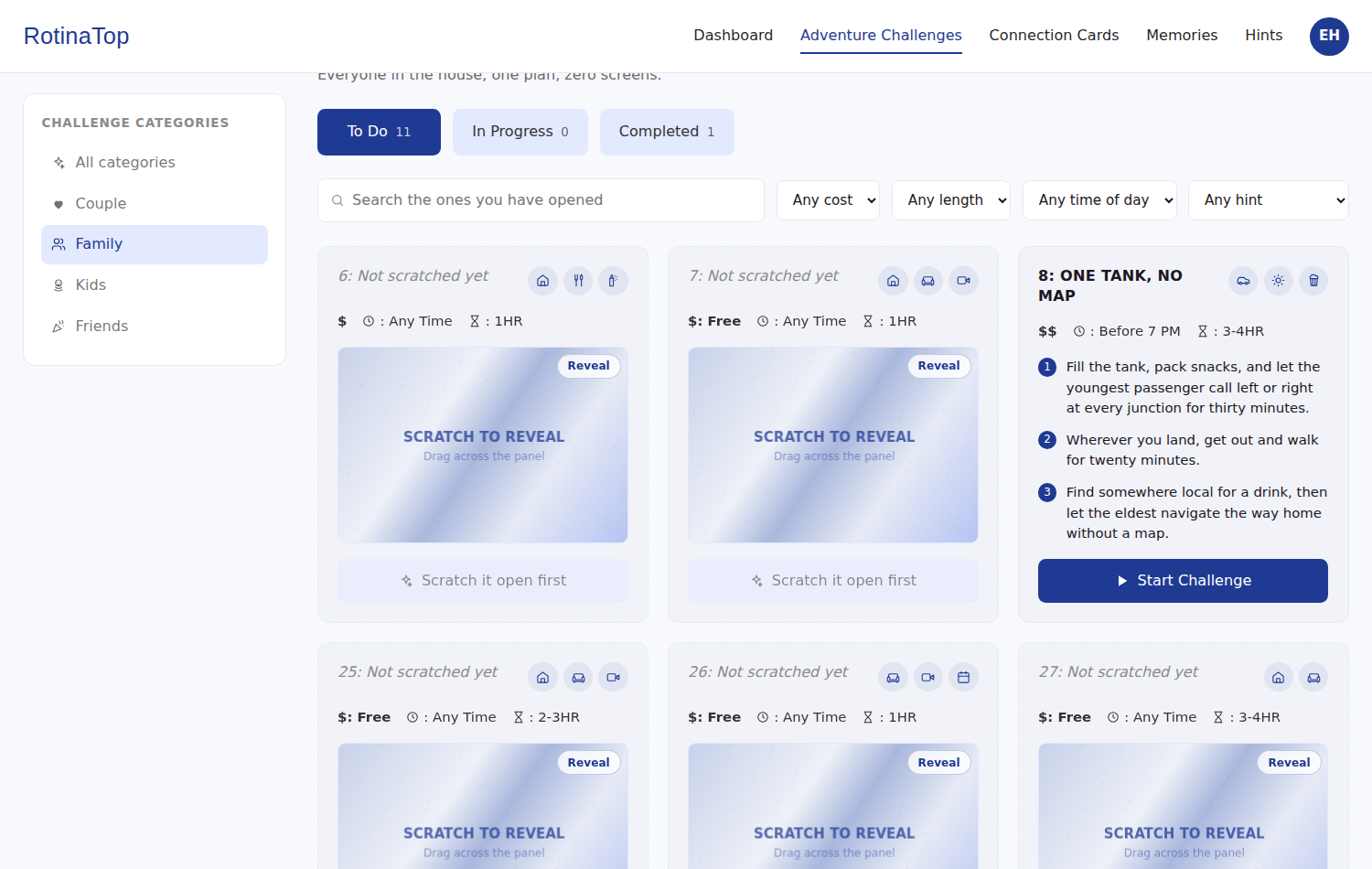
One Tank, No Map. Fill the tank, pack snacks, and let the youngest passenger call left or right at every junction for thirty minutes. Wherever you land, get out and walk for twenty minutes. Find somewhere local for a drink, then let the eldest navigate home without a map.
You should understand what this card just did to the power structure of that car. The six-year-old, a person whose most consequential daily decision is usually which sock goes first, is now the navigator of the entire family for thirty minutes, and takes to it like a small drunk emperor. Left. Left. RIGHT. The nine-year-old, appointed to get everyone home afterwards, spends the outbound leg in genuine strategic torment, trying to memorize a route their sibling is actively trying to make unmemorizable. The parents' only job is to drive and to not look at the map, which turns out to be the hardest step on the card.
They land somewhere. It does not matter where; a village with a café and a dog that follows them for two streets. The twenty-minute walk takes fifty. The drive home, navigated by a nine-year-old operating entirely on vibes and one remembered water tower, becomes the story the kids tell at school on Monday. Total cost: a tank of fuel and four juices. Total screen time: one photo.
That evening the card gets completed, the memory gets written (by the nine-year-old, as dictated by the six-year-old, edited by no one), and the Saturday that was dissolving at 10:15 exists now, permanently, in a feed only they can read.
The other deck, which hides nothing
If the foil were a philosophy, I would have put it on everything. I didn't.
Alongside the challenges sits a second deck, growing the same way: connection prompts for couples (thirty-six today, in four categories), and not one of them is hidden. There is no foil anywhere on that page. You browse them. You search them, and the search runs over the full prompt text, not just the titles, which is about as far from concealment as a design can get. You can filter by category, or press Draw a random card and let the app pull one out of the box for you. Each card keeps a private note you can edit forever, and any of them can be kept as a memory in the same feed the challenges write to.
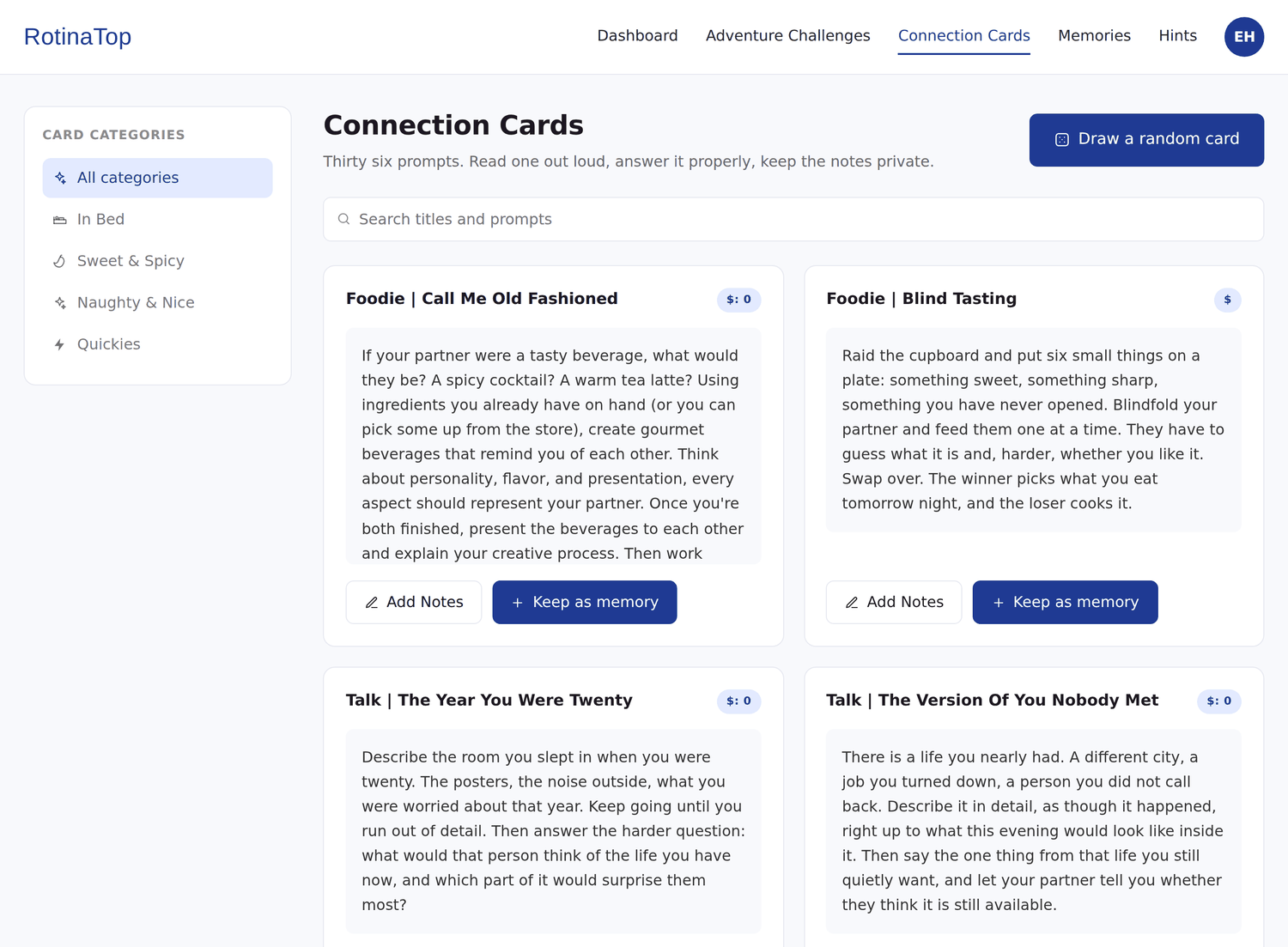
The app's own description of that deck gives away the reason: "Read one out loud, answer it properly, keep the notes private."
Read one out loud. That is why there is no foil.
A challenge asks you to commit an evening before you know what it is, and concealment is the thing that makes the commitment possible; you cannot comparison-shop a card you cannot read. A prompt is the opposite kind of object. Nothing about "describe the room you slept in when you were twenty… then answer the harder question: what would that person think of the life you have now" is improved by being hidden. It is a thing you say to another person. Sealing it would add ceremony and subtract nothing, and worse, it would put the friction in the wrong place: on the moment of deciding to ask, which is precisely where you want none.
So the two decks split on a single question: does the decision happen before you know the content, or after? A challenge costs you a whole evening, so you choose on terms and the content stays sealed. A prompt costs you one honest answer, so the content is open and the only thing kept private is what you say back.
Which is the honest form of the argument in the next section. The foil is not a belief about attention in general. It is a tool with a shape, and half my own product doesn't use it.
Why the foil matters
Everything in those two vignettes could, in theory, be done with a pencil and a jar of paper slips. I am at peace with that; the paper scratch books this app is modelled on are wonderful objects, and the app exists for the reason apps legitimately exist: the deck is always in your pocket, the memory feed cannot be lost in a house move, and the card that is "In Progress" keeps politely existing in a way a paper slip under a fridge magnet does not.
But the design carries three deliberate opinions, and they are the article's actual argument:
The hiding is the feature. An open list of every challenge in the deck is a menu, and menus invite the optimizing mind, the one that compares, defers, and ends up choosing nothing because something better might be three items down. That is the paradox-of-choice evening, and every couple knows it. The foil kills the comparison. You choose on terms (cost, time, energy) and commit before you know the content. It is the anti-feed: the feed shows you everything and asks for nothing; the card shows you almost nothing and asks for your evening.
The veto is load-bearing. Forced fun is not fun, and any system that ignores this gets abandoned by week two. The face-down veto lets everyone spend their "no" where it is cheap (on terms, before commitment) so that the "yes" that survives actually means something. Vetoing a face-down card costs nothing and hurts nobody. Vetoing a scratched card costs a small ceremony. The design puts the friction exactly where the commitment should harden, and nowhere else.
The memory is the product. Not the activity: the record of it, written by you, for exactly you and yours. In the Sparkling Water essay I measured how a machine's record of your habits cannot hold tonight's intention. This is the same truth from the other side: the record that matters is not the one a system keeps about you, but the one you keep on purpose. Nobody's algorithm learns from that memory feed. Nothing is recommended off the back of it. It exists so that in ten years, someone scrolling it finds the coin, the street market, the water tower. And the evening exists twice.
Whatever a machine can make gets cheap; your evenings it cannot make at all. There are, if you are lucky, about sixteen waking hours in a Saturday, and the number of them you will spend with a six-year-old who wants to shout LEFT at a junction is smaller than anyone believes at the time. The feeds will still be there at eleven. Scratch the card at half past eight.
Questions this article answers
Why hide the challenge until you scratch it?
Because an open list is a menu, and menus invite the optimizing mind, the one that compares, defers, and chooses nothing because something better might be three items down. A face-down card shows only its terms, cost, time window, duration and a few hint icons, so the commitment is made on the shape of the evening you actually have and the content arrives afterwards. It is the anti-feed: the feed shows you everything and asks for nothing, and the card shows you almost nothing and asks for your evening.
Isn't this just a jar of paper slips with an app wrapped around it?
Close to it, and that is not a complaint, because the paper scratch books this is modelled on are wonderful objects. The app earns its place on three narrow counts. The deck is always in your pocket, the memory feed cannot be lost in a house move, and a card sitting In Progress keeps politely existing in a way a paper slip under a fridge magnet does not.
How do you stop it becoming forced fun?
By making the no cheap and placing it before the commitment. Any card can be vetoed while it is still face down, on its terms alone, at no cost to anyone and no hurt to anybody, and what survives that round is a card that fits the hours the evening really has. A scratched card, by contrast, gets a fair hearing, which is the one place the friction belongs. Forced fun is not fun, and a system built on it gets abandoned by week two.
Why are the connection cards open when the challenges are hidden?
Because a prompt is meant to be read out loud, and that makes it the opposite kind of object. A challenge costs a whole evening and is chosen before you know what it is, so concealment is what makes committing possible; you cannot comparison-shop a card you cannot read. A prompt costs only the answer you give back, so all thirty-six sit open, searchable over the full prompt text rather than just the titles, and the only thing kept private is what you say in reply.
Read next
 Faith
FaithThe Sorrow at the Good
We live better than most kings who ever reigned, and the mood of the age is a low-grade sadness nobody can name. A fourth-century desert monk named it. An economist explained its mechanism in 1971. This is an essay about acedia (the sorrow that arrives precisely when the good does) and why an age of infinite abundance was always going to be its golden hour. AI
AIA Shelf, Not a Feed
The previous essay argued that when making is free, choosing becomes the work, and curation returns as a profession. Here I put it into practice: a site that takes the Vatican's 1995 film list, the one an office of the Holy See issued for cinema's hundredth birthday, and extends its discipline to books and music. Built in a day, in the visual language of vatican.va, with the humility clause kept in.